Abstract
The factors influencing charitable donation are complex. The major ones include cultural factors such as traditional historical and cultural values and charitable donation consciousness, as well as external social factors like the economic development level, tax incentive policy, as well as government regulation and social supervision mechanisms. The present chapter is mainly concerned with the cultural and social factors affecting charitable donation.
Explore related subjects
Discover the latest articles, books and news in related subjects, suggested using machine learning.
The factors influencing charitable donation are complex. The major ones include cultural factors such as traditional historical and cultural values and charitable donation consciousness, as well as external social factors like the economic development level, tax incentive policy, as well as government regulation and social supervision mechanisms. The present chapter is mainly concerned with the cultural and social factors affecting charitable donation.
4.1 Cultural Factors
When probing the reasons for the massive difference in the level of charitable donations between China and Western countries, many scholars have emphasized the significant influence of differing traditional cultural values.Footnote1 Generally, the traditional cultural values of a group of people refer to the mainstream core values internalized unconsciously by the group over a complex and lengthy process of historical practice, while the charitable donation awareness of a society reflects the general opinions on charitable donation, which is itself under the deep influence of its traditional cultural values. Despite the subjective nature of cultural awareness shared between them, the former is the cultural conception in a broader and more general and abstract sense, while the latter denotes a more concrete type of behavioral motivation.
4.1.1 Traditional Cultural Factors Influencing Charitable Donation
Cultural tradition and philanthropic cultural concepts exert a significant influence on charitable donation. One way of probing the influence of traditional culture on charitable donation is to clarify the internal mechanism of different cultural traditions and relevant philanthropic cultural concepts influencing charitable donation and related behavior. In Western societies, Christianity makes up the core of traditional culture. By contrast, the core of the traditional culture dominant in Chinese society is Confucian ethics. To explain the gap between China and the West in charitable donation behaviors and levels, we need to look for a cause attributable to cultural differences, so as to get a deeper understanding of the profound influence of traditional culture on the charitable donation mechanism.
The core of the Christian cultural tradition is the concept of “original sin and redemption,” from which the concepts of equality, tithe, and trusteeship were derived. The Christian concept of individual equality means that all are equal before God. Tithing means that individuals should donate one tenth of their wealth or income to the church or relief for poor. According to the Christian idea of trusteeship, the wealth an individual creates in the earthly realm is owed to the favor of God and from the grace given by God to his children, rather than something that belongs to the individual himself. The individual serves as a trustee of God’s wealth and after that wealth reaches a certain level they shall return a part of it to society in return for the grace of God. Even after they pass away, only a small part of their fortune will be left to their offspring as a legacy, while a larger part will be left to society. The Bible’s words that “It is harder for a rich man to enter the temple of heaven than for a camel to pass through the eye of a needle” and the Protestant idea that “It is a shame to die with a great fortune” preached in the Bible have also driven individuals to give their wealth to society. Thus, the Christian cultural tradition not only promotes individual donations through values, but also forms a complete and systematic system of ideas regarding charitable donation that has relatively specific operational norms. At least for Christians, charitable donations are driven not only by self-discipline but also colored by “compulsory” heteronomy.
Traditional Chinese charitable donations values largely rooted in China’s traditional classical culture dominated by Confucianism, that is, thinking of charity as being built with Confucian “benevolence” as the central pillar and including such concepts as people as the root, great harmony, righteousness and interests, filial piety, and fraternal love.Footnote2 Starting by supposing that human nature is fundamentally good, the thought has Confucian benevolence at the core, advocating that individuals, especially “the successful,” engage in benefaction. This is conveyed in the saying, “In times of hardship, one should first treasure oneself; In times of success, one is expected to benefit others.” Thus, the function of benefaction has been defined on this basis as a means of accumulating good deeds for rewards in this world or beyond, which has been described as “doing good and accumulating merit.” At the same time, philanthropy is built on patriarchal kinship relations, so it will increase or decrease in accordance with affinity of blood, ethnicity, and geography.Footnote3
Compared with the influence of traditional Western culture on charitable donation behaviors in the West, the influence of Confucian traditional culture on charitable donation behavior in China is embodied in more selected ways like the purely self-disciplinary orientation, the pattern of differentiation between close and distant relationships, and the familial view of wealth. The “selective rather than common” here refers to the concept of donation by the wealthy which is emphasized by Confucian traditional culture. It requires that successful people with considerable fortune and position fulfill the moral obligation of doing good and accumulating merit, though others do not necessarily have to do likewise. The so called “purely self-disciplinary orientation” means that the mechanism which brings about charitable donation mainly depends on an individual’s internal self-cultivation rather than on external altruistic discipline. In the pattern of differentiation of close and distant relationships, self-help and mutual help are more likely to be encouraged, while donations to strangers outside the pattern tend to be restricted. Differing from the view of wealth underlying the concept of trusteeship in the Christian tradition, Confucian culture stresses the view of familial wealth. An individual makes efforts and gains wealth more for the purpose of bringing glory to his ancestors and passing it on to and benefiting his offspring. Though the foundation in traditional culture and values should not be seen as the deciding factor bearing on charitable donation, the complexity and profundity of such influences still call for much attention.
4.1.2 Charity Awareness Affecting Donation Behaviors
Generally speaking, the awareness of charity concerns the complex of various conceptual forms such as motivation, consciousness, recognition, opinion, and feelings which the members of a society show in their charitable donation. It represents their knowledge, perception, and judgment they have developed regarding charity, as well as the resultant active participation. Analysis of charity awareness can be conducted from the two dimensions of motivation and the structure of awareness.
4.1.2.1 Diversity of Internal Motivation
Regarding the internal mechanism giving rise to charitable donation behaviors, generally speaking, there are two opposing opinions, i.e. rational choice and altruistic choice. When analyzing the awareness of charitable donation, many scholars start from altruistic viewpoints such as compassion and sympathy. However, such explanations simplistically attribute the internal mechanism for charitable donation behaviors to donors’ compassion, ignoring to some extent other possible motivating factors. Economists, when explaining the motivations underlying the phenomena of charitable donations have tended to take “homo economics” as given and thereby regarded the occurrence of charitable donation behaviors as the result of the donors’ rational choice, holding that donation behaviors can bring valuable private objects or realization of personal interests.Footnote4 On the whole, altruistic motivation remains the best theoretical explanation for the occurrence of charitable donation behaviors. After all, it is hardly possible to explain, either logically or practically, the phenomenon of voluntary provision of public goods including charitable goods through only rationality and self-interest.Footnote5
In addition to those based on rational choice and altruism, there are also charitable donation behaviors based on the psychology of mutual benefit and on the concept of trust. Scholars have found it hard to neglect “crowd-following” or “blindly following” behaviors in charitable donation that are caused by pressure from special environments or specific structures. Some scholars are of the opinion that the internal mechanism underlying charitable donation is complex and diversified, and that such complexity and diversity also manifest themselves in that the causes of specific donation behavior are mixed, involving multiple motivations such as a warm glow, social position, and social pressure.Footnote6 The empirical analyses by some Western scholars, such as Moe’s study of the industrial and commercial interest groups in MinnesotaFootnote7 and Mitchell’s investigation of some environmental protection groups also strongly support this view.Footnote8 Both offer in-depth explanations of the mixed motivations of donation behaviors. All these explanations provide theoretical support to the attempt to understand diversified charitable donation behaviors.
4.1.2.2 Hierarchical Awareness Structure
As the structure of charitable donation awareness is hierarchical, it can be divided into five levels. The first level is perception, which refers to the intuitive response to and understanding of charitable donation. The second is the knowledge, the various types of experience and scientific knowledge concerning charitable donation and related issues. The third is the charitable donation values, as well as the motivation for joining actively in charitable donation activities. The fourth is evaluation, which is concerned with charitable donation and related issues. The fifth is behavioral intention, referring to donors’ conscious orientation of motivating themselves to take part in charitable donation activities. We can simplify these five levels into three: the elementary level of awareness, which is the stage of obtaining knowledge of charitable donation behaviors, covering the aforementioned levels of perception and knowledge; the middle level, that is, the stage of approving and accepting charitable donation behaviors, covering the aforementioned levels of attitude and evaluation; and the advanced level, a stage of endorsing, believing, and advocating for charitable donation behaviors, i.e. the aforementioned level of intention (see Table 4.1).
Table 4.1 Levels of awareness structure
Full size table
Lower levels of charitable awareness are limited to only basic knowledge of charity concepts and an individual with such awareness does not have a strong willingness to make charitable donations. Before charitable donation is understood as a citizen’s responsibility and obligation, the behaviors of not donating or passively participating in donation are indicative of lower charity awareness. In fact, a sense of responsibility is at the core of charity awareness and, compared with other social responsibilities, charity responsibility is on the higher level. Just as different people reach different realms of morality, the charity responsibility embodied in different members of the society also differs across a gradient.Footnote9 An advanced level of charitable awareness refers to an individual gratefully seeing the relationship between himself and the society where he belongs and, aware of his social responsibility, thus repaying society directly and initiatively in a charitable way. Such realm of knowledge represents an advanced level of charity awareness that a society advocates and fosters.
4.1.3 China’s Current Charity Awareness
Having entered the twenty-first century, China has witnessed the rapid growth in the total volume of charitable donations. From 2000 to 2012, the annual chained rate of increase for social donations was about 53.9%,Footnote10 and the chained relative increase rate in the special years of 2003 (the SARS epidemic) and 2008 (the catastrophic Wenchuan earthquake) respectively reached 115 and 260%. These changes reflect the enhancement of charity awareness in contemporary China, but cannot cover up the extant lagging behind and passivity, as well as the low degree of development.
The lag in charity awareness is indicated by the following two facts. On the one hand, the overall level of the charitable donation awareness in China lags far behind the overall level of China’s economic and social development, with a very obvious cultural lag behind the rapidly developing economy and the overall development level of Chinese society. On the other hand, Chinese charitable donation awareness shows passivity and lags behind the development of the charitable donation level of the country. Here the “passivity” refers to, as far as why it occurs, too much dependence on top-down government pushes, featuring weak bottom-up endogenous development.
The frequent occurrence of mandatory and passive donation behaviors is typically indicative of the passive features characteristic of charitable donation awareness in China. For example, in the “One Day Charity” activities, certain sums are automatically deducted from the salaries of the civil servants and employees of government agencies and public institutions, while at the same time instances of “compelled donations” and “extorted donations” have continued to occur. Although such phenomena of “being forced to donate” contribute to lifting the absolute total of charitable donation, they are detrimental to the cultivation of charitable donation awareness and, to an extent, restrain the normal development of charitable donation awareness on the part of Chinese citizens.
Compared with developed countries in Europe and America, development of charitable donation awareness in China is, on the whole, still at a low level. As concluded by a survey in 2003 of Chinese citizens’ charitable donation awareness, “There has not developed self-conscious and strong charity awareness in the whole society.”Footnote11 According to a similar survey conducted in 2012, “In China, there are still groups of the people whose charitable donation awareness is yet to be enhanced.”Footnote12
4.1.4 Main Paths of Elevating Charity Awareness
The influence of public policies on charitable donation awareness tends to be through direct standardization and guidance, while having strong operability. The influence of modern media and public opinion on the general public’s awareness of charitable donation should not be ignored either. Thus, this section will probe the main paths of elevating charity donation awareness from the two angles of social policies and cultural advocacy.
4.1.4.1 The Path of Public Policy
The policy-based approach to elevating China’s charity donation awareness is to eliminate obstacles hindering organizations and individuals from entering the charitable domain, strengthen process supervision, and improve the incentive mechanism, primarily by introducing public policies. First, more effort should be made to remove barriers in registration and management of social organizations, so as to expand the applicable scope for organizations and to broadly implement the policy of allowing social organizations to apply to register directly with civil affairs departments. Thus, the general public’s enthusiasm to engage in charity can be greatly invigorated, promoting their actively taking part in charitable donation. Second, administrative dominance should be further mitigated and, by adjusting relevant policies, officially run NPOs should be gradually turned into charity organizations enjoying relatively high levels of independence, changing the monopoly position of officially-run NPOs in the charity market. Thus, the efficiency of allocating charitable donation resources can be bettered and the strength of non-governmental charity organizations can be boosted. Thirdly, process supervision should be further intensified and the credibility of charity organizations should be elevated by setting up mechanisms for assessment, ensuring openness and transparency, and elimination and exit suitable to the actual development level of the China’s charity donation undertakings. Such measures help remove the public’s various misgivings over charity organizations, gradually fortify the public’s confidence in charitable donation, and stimulate their internal vigor to donate. Finally, the policy-based incentive mechanism applicable to different subjects when donating should be improved. By adjusting the tax law, the preferential taxation policies oriented toward enterprises as donors should be improved and implemented more effectively, the tax deduction rate for individual donations should be increased in a reasonable manner, and the conditions required to apply for the tax deduction should be simplified. These policy-based means can be used to guarantee the effect of economic incentive mechanisms and to satisfy the needs of various donation subjects to make rational choices in return for benefits.
4.1.4.2 The Path of Cultural Advocacy
The path of cultural advocacy refers to the method of exerting a subtle influence on the public and enhancing their modern charity awareness by means of the developed mechanism of modern communication.
Firstly, following philanthropy objectively. The “objectively” here means that when stating and commenting on a charity event, the media should rationally assess the significance of charity and its future prospects, reducing as much as possible the negative influence of subjective factors like radical views and suppositions, and understand those unavoidable problems of charity’s initial development stage, avoiding as much as possible fragmented and isolated news or such ways of reporting.
Second, giving full play to the positive function of the media to construct a healthy social and cultural atmosphere for nourishing charity awareness. The influence of news media on charity donation awareness can be realized by constructing values and concepts. Both core values of the society like integrity and friendliness, which are closely related to charity, or views of wealth and the rule of law, which are closely related to charitable donation behaviors, can be shaped and solidified by the public opinion promotion in the news media.
Lastly, enhancing the public’s capability to distinguish between true and false charity information. Events in recent years, such as Meimei Guo flaunting wealth and Suntech’s “charity fraud” caused more and more people to question charity organizations. Though some of the incidents are not made up by the media, there is a considerable amount of exaggerated information based on hearsay evidence. In this era of “We Media,”Footnote13 when a public event occurs, the media should, as much as possible, avoid false information and misleading the public. Charitable organizations themselves should adhere to a just and transparent operation mechanism and respond as soon as possible once any critical incident occurs, turning the “crisis” into an opportunity. By nurturing their own credibility, they can bolster the enhancement of social charity awareness.
4.2 Economic Factors
4.2.1 Economic Level and Charitable Donation
The influence of the economic level on charitable donations can be summarized as follows. Under different economic conditions, the available quantity of charity resources and development levels of different charity organizations both differ and the interactive combination of these two factors brings about differing levels of charitable donations. The main influence of China’s imbalanced regional donation on charitable donation is embodied in the charity donation level descending a “staircase” from the east through the middle and descending all the way to the west. As shown by the annual ranking of Chinese donors, the east, China’s most economically developed region, exceeds central and western China in donation volume, the atmosphere for social charities, entrepreneurs’ participation in public welfare, and the maturity of the public welfare and charity organizations.
4.2.1.1 Differences in Distribution of Charitable Resources
The economic level is an important factor determining the availability of charity resources. Generally, charitable resources are relatively abundant in developed regions and are capable of providing sufficient force for charitable donations. By contrast, charitable resources are relatively lacking in less developed regions and the donation capacity is correspondingly lower.
The marked difference in the distribution of charity resources is signified by the imbalanced regional distribution of both enterprises and industrial scale. Of the 63,314 large and medium sized industrial enterprises covered by the statistics issued by PRC National Bureau of Statistics in 2012, the 39,681 enterprises in the eastern China had business income equal to 62.9% of the national total, while the corresponding industrial enterprises of central and Western China accounted for 22.2% and 14.9% respectively of the total.Footnote14 According to data from the Forbes China Charity Rank, for the year 2014 the top ten corporate donors were all located in Beijing Municipality, Guangdong Province, Fujian Province, and some other eastern provinces (see Table 4.2). Corporations on the list from Henan, Shanxi, Sichuan and some other central and western provinces were all low in either donation volume or number of donations made.
Table 4.2 Provinces and regions where the top ten corporations on Forbes 2014 List of China’s Charity are located
Full size table
In some provinces where private economy is developed such as Zhejiang, private companies have already begun to play a main role in charitable donation. As shown data from the “2012 Report of Charitable Donations in China,” the amount given in 2012 by private companies reached 27.506 billion yuan, accounting for 57.98% of all enterprise donations. Since 2007, when nationwide donation statistics began to be released annually in China, the amount donated by private companies has been over half of the total given by enterprises. As the private economy in central and western China is clearly behind, charitable donations by the private enterprises in these two regions have not been the main source of income for charitable organizations located there.
4.2.1.2 Uneven Maturity of Charitable Organizations
The maturity of a charity organization as a major recipient of donations depends on the specific level of economic development. A charitable organization’s credibility and capability to integrate charitable resources clearly affects the volume of charitable donations it receives.
The growth of NPOs across the country is regionally imbalanced as result of imbalanced development between different regions. Whether in absolute number or capabilities, local NPOs are strongest in more developed eastern provinces, especially Jiangsu, Zhejiang, Shanghai, and Guangdong. The volume of funds raised by charity organizations in eastern provinces is clearly higher than in the central and the western provinces and an overwhelming majority of the charitable funds collected countrywide by charitable organization comes from eastern provinces.Footnote15 As the leading city in China’s Yangtze River Delta economic area, Shanghai has seen its philanthropy flourish. In 2013, the Shanghai Charity Foundation took in RMB 707 million in income from its programs to raise donations, far exceeding the capacity of other national public foundations. Excluding the Tibet Autonomous Region Charity Federation, in 2011 China’s 31 provincial charity federations, raised RMB 4.67 billion, of which 47% came from charity federations of the eastern provinces and only 28 and 25% from those of the central and western provinces respectively.Footnote16
Most of the funds raised nationwide are spent in the eastern provinces. In 2010, the statistics of thirty provincial charity federations shows that they spent a total of RMB 6.3 billion on charity, of which those in eastern provinces spent RMB 3.39 billion, accounting for 53.71% of the total (see Table 4.3).Footnote17
Table 4.3 Expenditure shares of three regions of China in 2010 among 30 provincial charity federations
Full size table
4.2.1.3 Regional Differences in Total Charitable Donation Volume
In philanthropy the economic level of a region can directly be seen through the level of charitable donations. Differences in regional economic development cause the uneven distribution of charitable donation resources, with total donation volumes in economically developed regions outweighing those of less developed regions.
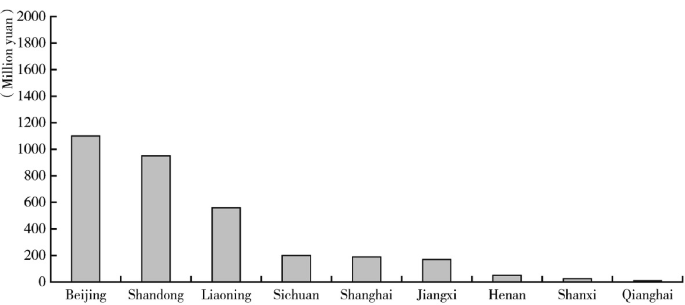
Analyzing samples of domestic data on donationsFootnote18 shows that in 2011 the three provinces of Guangdong, Beijing, and Fujian had the highest level of donations, with each over RMB 2 billion. The total volumes of donated funds and materials in Shanghai, Shandong, Zhejiang, and Jiangsu were all over RMB 1 billion. By contrast, some provinces in central and western regions such as Jiangxi and Xinjiang donated less than RMB 100 million.Footnote19 Additionally, according to data on social donations received directly by the civil affairs departments of the various provinces, municipalities and autonomous regions in 2013, the total donation volumes differed markedly by region. The amount directly received by the civil affairs departments of Guangdong alone reached as high as RMB 1.82 billion and those of Beijing and Shandong reached RMB 1 billion yuan, while those of Shaanxi and Qinghai received only a few million (see Fig. 4.1).Footnote20
Fig. 4.1
Source CPR Ministry of Civil Affairs (2013)
Total amounts directly received by civil affairs departments in ten provinces in 2013.
Full size image
4.2.1.4 Influence of Individual Economic Strength on Donations
An individual’s economic strength has particularly clear influence on their donation behavior and personal incomes level directly affects an individual donor’s capability to donate. Both the results of a survey jointly published in 2008 by the Shanghai Charity Foundation and Fudan University School of Social Development and Public Policy and also the data on Chinese citizens’ public welfare behavior that the Beijing Normal University School of Social Development and Public Policy obtained by surveying 27 Chinese cities in 2011, show the significant influence of an individual’s economic level on their donating behavior.
(1)
Weak personal economic capability is the main reason for not donating. A significant number of Shanghai citizens who had not donated in the two years prior said that their weak economic capabilities were the key reason for their donation behaviors. They made up 34.3% of all respondentsFootnote21
(2)
Significant positive correlation exists between an individual’s social and economic position and their charity donation behavior. Individual charitable donation behavior is subject to the influence of one’s own personal economic status. As their overall level of wealth rises, individuals will be more willing to participate in charitable donation activities. In the aforementioned Shanghai survey, more than 90% of respondents said that if their income increased, they would give more to charity (see Table 4.4). Based on a Tobit model of the survey data from Beijing University on Chinese citizen’s public welfare behavior, personal work income increased by 1%, and average donations increased by 0.25%.
Table 4.4 Statistics on relationship between citizens’ economic strength and their willingness to donate
Full size table
An individual’s income has a direct bearing on their donation amount, number of donations, and willingness to donate, while an enterprise’s donation level is subject to its stage of growth. Generally, an enterprise will experience three stages: the primitive accumulation stage, the stage when it pursues scale and expansion, and the stage when it strives to build itself as a corporate citizen.Footnote22 Most Chinese enterprises are still in the first two stages, that is, they are rising. In the primitive accumulation and expansion stages, enterprises worry about social donation increasing risk. When they stand on a firm economic basis they will strive to fulfill more of their social responsibility as corporate citizens and to engage in charity.
4.2.2 Impetus and Influence of the Economic Benefit Factor
There is an obvious positive correlation between charitable donation and the level of economic development. However, other economic factors that promote charitable donation should also be considered. An important one is the return in benefits brought about from charitable donation. This factor serves as the internal drive behind charitable donation behavior and the public’s awareness of participation.
4.2.2.1 Economic Benefits of Charity Organizations
Charity organizations are NPOs, but this does not mean that they cannot or should not obtain economic benefits from their operations. The launching and founding of many charity organizations, particularly most of the non-governmental or non-enterprise units, are naturally driven by certain future benefits. The sponsors or investors, though they cannot earn handsome profits, can obtain a relatively fixed income for the sustained development of their organizations. For example, the main areas into which a charitable foundation invests its capital include industrial entities, stocks, bonds, and insurance. Differing from an enterprise, which seeks economic interests and benefits so as to enlarge its market share, a charity organization sets greater store in the relevance of its economic benefits for the public welfare. Charity organizations’ participation in raising charitable funds and operating those funds is conducive to maintaining and increasing the value of their assets and, more than that, can effectively boost their independence and ability to offer services thus better fulfilling their positive function in serving public welfare. A charity organization which has a scientific system for operating its assets and has fostered high social credibility is a favorable factor for stimulating various social forces to participate in charitable donation.
4.2.2.2 Enterprise Benefits
Under a market economy, enterprises tend to treat charitable donation as an important means of competition. An enterprise needs to take into consideration both economic benefit and social responsibility, for, its existence depends just as much on social responsibility as it does on economic benefit. Social donation signifies tremendous social value for an enterprise, as it enhances its social image and is “the only way it must pass to ensure its sustainable operation”.Footnote23 First, social donation is, to a considerable extent, conducive to an enterprise bettering the management efficiency of its leaders, as well as enhancing employee cohesion and internal management. Second, through social donation, an enterprise can display its sense of social responsibility, which helps it win positive appraisals and trust from all sides and thus tighten its affinity with the relevant governmental departments and with all sectors of society. A scholar pointed out that, “As far as a transnational company in China is concerned, by providing various public welfare donations and supporting China’s education, it can give a favorable impression to the government and win its trust, and thus enter into sound cooperative relationship with the governmental departments, which should be a preferable path to participating indirectly in politics.”Footnote24 Last, an enterprise making strategic donations can better its environment and add to its competitive advantage. When an enterprise invests strategically to those mutually beneficial areas of charity which can bring about both social and economic benefits, it can increase its sales income and thus have success in both public welfare and its own performance.
To an enterprise, proper participation in public welfare donation can be a special marketing tool described as “Cause-Related Marketing.” This refers to the type of corporate charity activity by which an enterprise can fortify its own capability to make money. This type of corporate charity activity can be combined with specific marketing activities or be organized jointly by an enterprise and an NPO, particularly a charity organization.Footnote25 In this way, if an enterprise, by choosing a public welfare area favorable to the sales of its products, makes donations and also calls for others to donate, it will ultimately expand its market influence and increase its profits. As a new marketing tool, Cause-Related Marketing has become increasingly popular among enterprises, as it considers benefits for enterprises, consumers, and society, and thus wins extensive support from all sectors of society.
4.2.2.3 Individual Benefits
According to social exchange theory, charitable donation can directly or indirectly bring benefits that include internal and external rewards to the donor. The “internal reward” refers to the direct return, like love, gratitude, satisfaction of interests, or sense of honor from a social exchange relationship that a donor establishes in the process of donating. The “external reward” refers to a return from elsewhere, which generally means the realization of relatively long-range objectives in future, such as gaining status, obtaining assistance, or being obeyed.
Additionally, an individual’s motivation to donate can also be avoiding taxes. For example, as the rate of inheritance tax in Western countries is progressive on the basis of a surtax system (the highest rate can be about 50%), many rich people are liable to give their fortune to charity. Since China has not begun to levy inheritance taxes and gift taxes, it has not established an “anti-driving” mechanism in which the inheritance tax and gift tax can restrict the transfer of fortunes and thus promote charitable donation. Due to the absence of these types of taxes, many people of the high-income class prefer to leave their fortunes to their relatives rather than give them to social charitable undertakings.
4.2.3 Paths for Promoting the Benefit Feedback for the Development of Charitable Donations
Paralleling the great efforts which have been made to increase incomes, the tax system and other supporting measures need to be improved to protect donors’ appropriate benefits, so that charitable donation behaviors can be durably and effectively stimulated, thus promoting the sound growth of philanthropy.
As far as a charity organization is concerned, it needs to start by ensuring the basic operations of its funds and then seek a breakthrough in accessing secure investments. Firstly, the public financial support from the government is an indispensable economic resource for a charity organization. Take developed countries and regions as an example. The social donations available to a charity organization, though an important income source, do not make up the only source, as a considerable part of its funds comes from government financial investment.Footnote26 An example is Hong Kong Special Administrative Region, which allocates funds for local non-governmental charity services and undertakings, objectively guaranteeing charities serving as an important pillar supporting the social security system. Thus, the charity domains and levels to be supported by government finance and the channels for that purpose should be clarified, and by formulating proper policies, institutional financial support should be provided for charitable organizations, reducing the funding pressure on them in their long term development process. Secondly, with regard to maintaining and increasing the value of their assets, charity organizations should be, getting past the restraints from their public welfare status and under the precondition of ensuring the security of their funds, encouraged and guided to maintain and increase the value of their assets by means of the various ways available in the money market. At the same time, the demarcation line between the operable capital and the donation income of charitable organizations should be made clear and the accounting of their financial affairs and their tax treatments should be handled differently.
As far as enterprises are concerned, maintaining fair competition in charitable donation, with different systems of enterprise ownership on an equal footing, is also an important means of promoting corporate donations. Currently, the evaluation of corporate donation behaviors is based more on the absolute amount than on the relative donation capacities or donation ratios of different types of enterprises. This is unfair to a large number of private enterprises which are not state-run monopoly enterprises, yet which take active part in philanthropy. Therefore, the future system of social evaluation which will guide enterprises as donors should fully respect enterprises’ own economic strength, emphasize their autonomy in carrying out strategic donations, and offer suitable preferential policies to them as a stimulus, thus creating a sound environment where, as donors, they can engage in benign competition.
As the web and electronics technology develop rapidly, many forms of new media have become easily accessible. This has brought about more convenient channels for charitable donors to obtain reputational feedback. Charity organizations can, by designing and operating a series of information platforms, satisfy the emotional and moral needs of individuals’ donation behaviors. Thus, after individuals make donations, the immediate and effective spreading of the information is beneficial both to affirming the value of the individual donation behavior, so as to give feedback to the individual donors, but also to have them serve as a model for others.
4.3 Tax Factor
The impact of taxes on charitable donation is mainly reflected in the implementation of the preferential policies for charitable donation through relevant laws and regulations of the tax law and tax departments, thus stimulating enterprises, individuals, and other organizations to actively participate in social charitable and donation undertaking.
4.3.1 Influence of Taxation on Enterprise Donation
The most direct and explicit return brought about by charitable donation is a reduction in taxes. When an enterprise reduces its amount of tax payment by making donations, it is actually a tax transfer made by the government. If an enterprise put a part of its profits into social public welfare undertakings, it decreases the government’s operations among the intermediate links, greatly increases the funds available to the charitable undertakings, and indirectly lifts its corporate performance, and thus is conducive to overall social and economic development. In China, the current basic income tax rate is 25% for enterprises, 20% for those small and low-profit enterprises and some overseas enterprises, and 15% for new hi-tech enterprises.Footnote27 Different types of enterprises may, according to different preferential taxation policies, choose themselves different recipients and donation channels. Enterprises with low annual taxable income can fully use the different rates of preferential taxation and readjust their charitable donations in order to reduce their tax burden and maximize their benefits. As for large enterprises, since tax policies for public welfare donations are closely related with their total final profits, they have to consider fully the interests of all shareholders (particularly medium and small shareholders) before making donations and attempt to design suitable donation schemes which maximize the efficiency of their donations and at the same time avoid hurting the interests of their shareholders.
Of the current categories of tax in China, the two which significantly influence corporate donations are the value-added tax (a tax on turnover) and the corporate income tax (an income tax). The influence of value-added tax on the donation activities of an enterprise affects, generally speaking, its non-cash donations, for when its products have not entered into the market the tax burden is fully shouldered by the company itself. As stipulated in the Interim Regulations of the People’s Republic of China on Value-Added Tax, when an enterprise turns over the goods produced by itself, made through consigned processing, or purchased, as gratis gifts to others, they should be regarded as sales, subject to financial accounting, and according to the composite assessable price computed on the basis of the average prices at which the taxpayer or other taxpayers in a recent period sell the same type of goods, the sales volume shall be decided and the corresponding value-added tax shall be paid according to law.Footnote28 Therefore, donating behaviors will incur payment of value-added tax to a real extent. According to the current stipulations on the value-added tax, when donating something, an enterprise may choose different materials for donation so as to minimize its corporate tax burden. This is the main influence of value-added tax on its donation behaviors.Footnote29 As for the enterprise income tax, it divides the ways in which an enterprise makes public welfare donations into different categories, each enjoying a different preferential policy (see Table 4.5). The latest enterprise income tax in China cancels the provisions for the full tax deductions being applied to public welfare donations given by enterprises via NPOs to some areas such as the Red Cross Society and public benefit sites designated for teenagers’ activities, as well as donations by foreign enterprises. However the full tax deduction is still applicable to special public welfare donations for disasters and important incidents. Instead, according to the new provisions, the donated amount can be deducted to an extent not exceeding 12% of total profits. It is also stipulated that anything below the quota of public welfare donations which are not deducted and the amount donated above the quota of the fiscal year cannot be carried over to the next year. This will promote an enterprise, when choosing specific means of donation and quotas, to fully consider how to maximize its benefits.
Table 4.5 Provisions in current laws and regulations for preferential taxation of enterprise charitable donations
Full size table
4.3.1.1 Positive Influence
The current laws and regulations provide clear provisions for the preferential taxation of the donations made by enterprises at home and abroad. Among them, the “Law of the Peoples Republic of China on Donation for Public Welfare Undertakings” (1999) stipulates that the public welfare donations made by companies and other enterprises according to law enjoy preferential income taxation; the import duties of materials donated from outside the borders to Chinese public welfare undertakings and the value-added tax from the import process can be reduced or exempted.Footnote30 According to the revisions made in 2007 to the “Law of the People’s Republic of China on Enterprise Income Tax,” the percentage of pre-tax deduction on donations rose from 3 to 12%, the base for tax exemption changed from the previous total taxable amount to the yearly total profit, and the amount of donation for preferential tax deduction was made uniform for both Chinese funded enterprises and foreign funded enterprises. All these changes indicate that the Chinese government is supporting strongly corporate donation behaviors through introducing more favorable tax exemption policies.
Additionally, more and more public welfare organizations have been qualified for pre-tax deductions for donations. In 2008, there were 66 social organizations for public welfare registered with the Ministry of Civil Affairs and entitled to the qualification for pre-tax deductions for public welfare donations, while by 2012 there were 148. 2013 saw 170 social organizations for public welfare qualified in two groups successively by Ministry of Finance, State Administration of Taxation, and Ministry of Civil Affairs for pre-tax deductions for public welfare donations. This increase is conducive to gradually expanding the channels for social donations, lowering the threshold for enterprises to make public welfare donations, and enlarging their range of possible means of donation to choose from.
4.3.1.2 Problems
The effect of the tax incentive mechanism depends on whether the tax system is designed scientifically and reasonably and also whether it is put fully into practice. Currently, there are still some problems preventing the tax system from playing its incentive role that involve both inadequate demand for preferential tax policies and institutional obstacles.
Tuan Yang and Daoshun Ge’s survey finds that many enterprises are not very eager to obtain tax exemptions on donations. The main reasons lie in that the donated amounts are low, the procedure of applying for deductions is complicated, and the tax deduction involving donated materials is not easy to handle, among others. Besides, as the tax deduction is a behavior that comes after the donation behavior, the possible transaction cost determines whether it is worthwhile to apply for that deduction, and, what is more, since a great many donations made by enterprises are disbursed from their costs, welfare expenses, non-business expenditures, and administrative operating expenses, they do not need to apply for tax deductions.Footnote31
The reasons why Chinese funded companies seldom consider applying for tax exemption are as follows. Firstly, they have not been fully informed of the policies on the pre-tax deduction of donations. Secondly, their donations are disbursed in the cost expenses. Thirdly, it is difficult to apply for an exemption for donated materials and donations by employees. Foreign funded companies, though more familiar with the relevant policies of tax deduction and exemption, have found it challenging to handle their applications. There are two main reasons for this situation. First, it is hard for them to get proof for the tax exemption. To get the proof, they must have their donations to go to designated charity organizations. As foreign funded companies have relatively more programs of their own for mutually beneficial donations, they do not necessarily donate via a designated charity agency and thus have trouble obtaining the relevant proof. Second, as foreign funded companies in China have enjoyed a preferential tax deduction for many years, applying for tax deductions or exemptions for low-volume donations, donated materials, and donations by employees is relatively unimportant.Footnote32
Currently, the main obstacles enterprises are faced with in realizing the tax deduction and exemption of their public welfare donations are as follows. Firstly, judging from the results of tax incentive policies, the current preferential taxation of charitable donations has produced different effects on enterprises with different systems of ownership. As the administrative mechanism plays a dominant role in the management of SOEs, the tax deduction and exemption policies exert little influence on them. For the private enterprises, the situations in different regions are quite different. In some regions, the local taxation departments decide on a fixed rate for taxable income on the basis of enterprise income, from which the tax can be computed directly. Thus, the charitable donation level has little to do with the corporate taxation. Secondly, regarding the donation channels, as it is stipulated by law that direct donations to recipients do not enjoy tax deduction and exemption, and, in fact, many enterprises give donations directly or via social organizations for public welfare. Many of these recipients are not qualified for tax deduction and exemption or to issue tax exemption invoices, so the influence of the tax deduction and exemption policies is very limited for these enterprises. Thirdly, looking at donated assets, many Chinese companies give non-cash donations, and, in addition to non-cash donations such as materials and services, the number of equity donations has been growing rapidly. As provided for in “Circular on Financing Issues of Enterprise Equity Donations for Public Welfare” issued by Ministry of Finance in 2009, natural persons, legal persons that are not state-owned enterprises, and other enterprises held by economic organizations as investors can make equity donations, while SOEs cannot allowed to do so. At present, as the practice of the tax deduction and exemption on equity donations is still in a pilot stage and, what is more, the current taxation system is not clear on the pricing standard for non-cash donations. These all affect the role played by tax incentives.
4.3.2 Influence of Taxation on Individual Donors
4.3.2.1 Individual Donation Tax Policies
Regarding measures for preferential taxation on individual charitable donations, the current “Law of the People’s Republic of China on Donation for Public Welfare Undertakings” (1999) expressly stipulates that “When donating property for public welfare undertakings according to the provisions of this law, natural persons, individual businesses of industry and commerce may be given preferential treatment in individual income tax according to the provisions of laws and administrative regulations.”Footnote33 Though the “Law of the People’s Republic of China on Individual Income Tax” has been revised for five times in the period from 1999 to 2011, the sections concerning provisions for preferential taxation of charitable donations have remained substantially the same. It is stipulated that “The part of individual income donated to educational and other public welfare undertakings, shall be deducted from the taxable income in accordance with the relevant regulations formulated by the State Council.”Footnote34 The “Regulations for the Implementation of the Law of the People’s Republic of China on Individual Income Tax” (2011) specifically stipulate that “The donation by individuals of their income to educational and other public welfare undertakings, and to areas suffering from serious natural disasters or poverty, through social organizations or government agencies in the People’s Republic of China. That part of the amount of donations which does not exceed 30 percent of the amount of taxable income declared by the taxpayer may be deducted from his amount of taxable income.”Footnote35 At the same time, tax incentives oriented towards taxpayers’ charitable donations also involve such preferential taxation such as on properties and behaviors. At present, China has not introduced any policy of preferential taxation on commodities, due to the limitation of inadequate identification of donation behaviors among the circulating links and also to prevent some taxpayers from going into profit-seeking activities in the name of charitable donation.
4.3.2.2 Weakness of the Present Tax Incentive Policies for Individual Donations
Currently, there are some illogical parts of the design of the taxation system for individual donations. If an individual donor fails to choose the proper mode and channel of donation, it is possible that, after giving a donation, he has to make a supplementary payment of the income tax. This may cause another result, that is, rather than donating to a public welfare organization, a donor may donate directly to the donee or not donate at all. However, in the actual process of donation, a great number of individuals do not know much about the policies and articles concerning donation, resulting in them receiving less than the benefits they deserve or even unknowingly violations of law. In 2005, the civil affairs system received a total of 1.7 billion yuan individual donations nationwide, yet the individual tax refund rate was zero.Footnote36 Compared with the developed countries and regions, China’s donation policy is singular and flawed. The incentive function of tax policy is inadequate, which is embodied in the following aspects.
Firstly, it is difficult to get the proof required to apply for individual tax relief. The conditions for enjoying tax deduction and exemption are relatively rigorous and only by donating to public welfare organizations identified by governmental agencies as qualified for pre-tax deduction on public welfare donations can an individual take advantage of the tax refund policy. Currently, only a small number of officially run public welfare organizations such as China Charity Federation, Project Hope Foundation, and the China Foundation for Poverty Alleviation have the authority to issue the proof required for qualification to apply for tax deduction and exemption, while regular donations in large quantities to community-based charity or service organizations cannot obtain such proof. This is disadvantageous to encouraging social donations. When individual citizens make direct donations to the receiving units or individual recipients, they cannot get pre-tax deduction of income tax.
After a work unit or an enterprise organizes its employees to make individual donations, usually it can only be offered a uniform donation certificate, while individual donors cannot get their own donation receipts. As for the civil servants in government departments, since their income taxes are withheld and remitted by the financial agencies, they have to go through a complicated process involving transferring documents and handling the tax deduction formalities if after their donating behaviors they need to apply for tax deduction or exemption. Additionally, in the case of a man and his wife donating their common property, questions such as how to divide the deducted amount and how to separate their donation receipt need further study.Footnote37
Secondly, the procedure of refunding donation tax is complicated. China’s current procedures for handling individual donation tax deduction and exemption are very complicated. When some enterprises apply for handling the tax exemption formalities after their making donations, they even have to resort to use of guanxi. An overwhelming majority of employees have participated in various material or cash donation activities organized by their communities or work units, but almost none of them have attempted to apply to the taxation departments for any income tax exemption. A senior official in charge of donation and relief work in a government agency once donated 500 yuan purposely and it took him two months to go through ten steps before he got a 50 yuan tax exemption.Footnote38 This case exposes the tedious tax refund process. Many taxation agencies do not even set up a standard procedure for handling the tax refund affairs.
Thirdly, there lacks a mechanism for an “anti-driving” effect. As the inheritance tax and gift tax restrict the transfer of property, they can produce the effect of anti-driving donations. However, China has not introduced these two taxes, which has pushed, to some extent, people to accumulate wealth or pass it on to their offspring rather than donate it to society or charity organizations. As shown by experience, the inheritance tax and gift tax exert considerable impact on donations. The inheritance tax belongs to the category of property taxes and the object of taxation is the net value of the property left by the deceased owner. At present, more than a hundred countries levy an inheritance tax. Collecting this tax will supplement and improve the state’s tax sources, and also be beneficial to adjusting the societal wealth gap. The gift tax levied on property gifted by its owner to others before their death is a subsidiary tax to the inheritance tax, aiming at preventing the property owner from transferring his property when alive in order to have the inheritance tax on property after his death reduced.
4.3.3 Influence of Taxation on the Income of NPOs as Recipients of Donations
4.3.3.1 Preferential Taxation Factors Promoting NPOs as Receivers of Donations
1.
Guarantee and promotion on the legal level
The provisions for preferential taxation of the donation income of charity organizations are found in the “Regulations of the People’s Republic of China on the Administration of Foundations” (2004), the “Interim Regulations of the People’s Republic of China on Value Added Tax” (2009), the “Law of the People’s Republic of China on Customs” (2013), and documents issued by the PRC Ministry of Finance and State Administration of Taxation such as the “Circular on Issues of Identification and Administration of NPO Status for Tax Exemption.” Some of them stipulate that the donation income of NPOs (including charity organizations) meet the favorable conditions required for tax exemption. The incentive for materials charitable organizations receive from overseas donors is mainly provided by preferential import value-added taxation and preferential tariff treatment. For example, import duties and the value added tax on the import chain are exempted for materials directly donated gratis for poverty assistance or charity by overseas donors to the following six social organizations: the Red Cross Society of China, National Women’s Federation, China Disabled Persons Federation, China Charity Federation, China Primary Health and Care Foundation, and Song Qingling Foundation.Footnote39
2.
Regulations and rules closely linked with relevant tax laws
Existing rules and regulations are continuously updated and old ones are replaced in a timely manner. For example, regarding the regulations on the recognition and administration of NPOs’ qualification for tax exemption, in recent years, the regional limitation on NOPs’ public welfare activities has been lessened, with the original phrase “the range of activity is mainly limited within the Chinese borders” being abolished and the scope of NPO income from public welfare activities that preferential taxation applies to has been expanded. These will facilitate the promotion of charitable donations in China and abroad.
4.3.3.2 Obstacles Hindering NPOs from Enjoying Preferential Taxation for Charitable Donations
(1)
Many public welfare charity organizations have difficulty in qualifying for tax exemptions or pre-tax deductions of their income from public welfare donations. Preferential taxation for public welfare donations has two meanings. One is preferential income taxation of public welfare donations received by NPOs and the other is pre-tax deduction of income tax payable for donors who make public welfare donations. These two preferential taxation policies are subject to, respectively, the prerequisite that a charity organization is qualified to have its income from public welfare donations exempted and that the organization is qualified for pre-tax deduction of the public welfare donations. Increasing the difficulty of obtaining these two special qualifications will not be conducive to improving the ability of charitable organizations to attract donations, which in turn will affect realizing tax deductions of the organization’s own income.
Regarding qualification for income tax exemption on their incomes, up to 2012, only 30% of China’s charity organizations have registered with the PRC Ministry of Civil Affairs and qualified for tax exemption of donation income. At the same time, the situation for qualifying for pre-tax deduction of public welfare donations is not positive. A majority of social organizations, particularly non-governmental and non-enterprise public welfare units, are excluded and not entitled to issue financial instruments to donors for their public welfare donations. Take Ningbo, Zhejiang Province, for example. In that city, where public welfare charities are relatively developed, only 53 social organizations are currently qualified for tax exemptions, accounting for less than 1% of the total and only 32 social organizations have qualified for pre-tax deduction of public welfare donations, accounting for only 0.6% of all social organization legal persons. Those that have qualified are basically limited to foundations and charity federations.Footnote40
Meanwhile, in China’s current tax system, when a donor makes public welfare donation via different charity organizations, they have to face different preferential taxation policies. In particular, the gap between governmental and non-governmental charity organizations’ capacity to attract donations through preferential tax policies is too large. The special full donation amount deduction only applies to donations given to charity organizations that are approved, founded, and recognized by the state, such as the Red Cross Society of China, China Aging Development Foundation, China Welfare Fund for the Handicapped, China Education Development Foundation, and China Foundation for Poverty Alleviation. Donations given directly to community charities or service organizations cannot obtain tax deduction certificates. This restricts the role played by non-governmental charity organizations in mobilizing social resources and adopting flexible forms of raising donations.
(2)
The non-profit nature of NPOs is not salient enough. Being a non-profit is an important precondition for a charity organization to enjoy preferential taxation of its donation income. At present, in the field of public welfare in China the distinction between profit-seeking and the non-profit agencies is not very clear. Fields other than medical and health services (such as education, science and technology, culture, sports, and social welfare), lack a clearly defined demarcation between non-profit and profit-seeking organizations and the relevant behaviors of these organizations, resulting in both non-profit and profit-seeking organizations sharing preferential tax treatment in spite of their differing behaviors.Footnote41 This confusion engenders the possibility of preferential taxation policies oriented towards charity organizations easily being illegally taken advantage. This is to the detriment of the public welfare role and social image of charity organizations, which will reduce the recognition of social forces and trust in the identity of charity organizations as serving the public interest. It will even depress the public’s enthusiasm to participate in social donations.
4.3.4 The Implementation and Improvement of Tax Incentives for Public Welfare Donations
The “Interim Procedures for the Use and Management of Bills of Donation to Public Welfare Undertakings” issued by PRC Ministry of Finance in 2011 is conducive to public welfare donations in China gradually operating in more standard ways. The third plenary session of the 18th Central Committee of CPC made it clear that “more efforts shall be made to improve the system of tax deductions and exemptions for charitable donations and support the charitable undertakings playing an active role in poverty alleviation.” At an October, 2014 executive meeting of the PRC State Council, Premier Li Keiqang, emphasized once again that “The policy of tax deduction and exemption for public welfare donations should be implemented well and improved, more measures encouraging charity should be introduced, and the development of charitable organizations with poverty alleviation functions should be prioritized.”Footnote42 This signal points again to preferential taxation policies which function as incentives to charitable donation. We suggest that the following two measures be adopted to ensure that the policies of tax deduction and exemption on donation income can be practiced effectively to solve existing problems in that area.
First, enlarging the scope of preferential taxation policies. The latest enterprise income tax law raises the proportion of tax deduction for public welfare donations, yet there is still room for increasing the individual income tax deduction for charitable donations. To elevate level of benefit made possible by those preferential taxation policies, all the links involved in the process should be considered. Firstly, support various types of charity organizations enjoying the qualification of tax exemption on their income from public welfare donations. Secondly, allow the charitable donation of an enterprise in excess of the quota to be rolled over to the next year for deduction, so as to encourage the enterprise to increase its donation volume as much as possible. Lastly, make sure that the formulated preferential taxation policies oriented towards public welfare donations apply to different donated contents and forms, and effective tax incentive measures oriented toward diversified donation forms should be introduced in timely fashion.
Second, improve the operationalization of qualification for tax exemptions. Civil affairs departments can join hands with finance and taxation departments in optimizing and implementing the process of qualifying all types of charity organizations for tax reduction and exemptions. They can also strengthen efforts to publicize the preferential taxation policies so that the charity organizations are well informed of the specific standards, requirements, and procedures for applying and handling applications. At the same time, the policy constraints on non-governmental charity organizations should be suitably relaxed and the blind spots and gaps in the existing preferential tax policies should be made up for or filled out, so as to put into effect to the greatest extent the preferential tax policies oriented toward public welfare charity organizations. Additionally, charity organizations’ capability of raising donations should be boosted correspondingly and their opportunities to receive donations should be increased so that the incentive of preferential tax policies for charitable donations can be functional and fulfill its purpose.
4.4 Internal and External Supervision Mechanisms
Usually, supervision and regulation involve governmental supervision and regulation, social supervision, and charity organization self-regulation. The supervision and regulation of the donors, recipients, and their behaviors are beneficial to boosting the transparency of donations, fortifying the credibility of charitable organizations, and guaranteeing that enterprises and individuals fulfill their social responsibility. Therefore, the supervision and regulation mechanism plays an important role in maintaining the environment for charitable donations (see Fig. 4.2).
Fig. 4.2
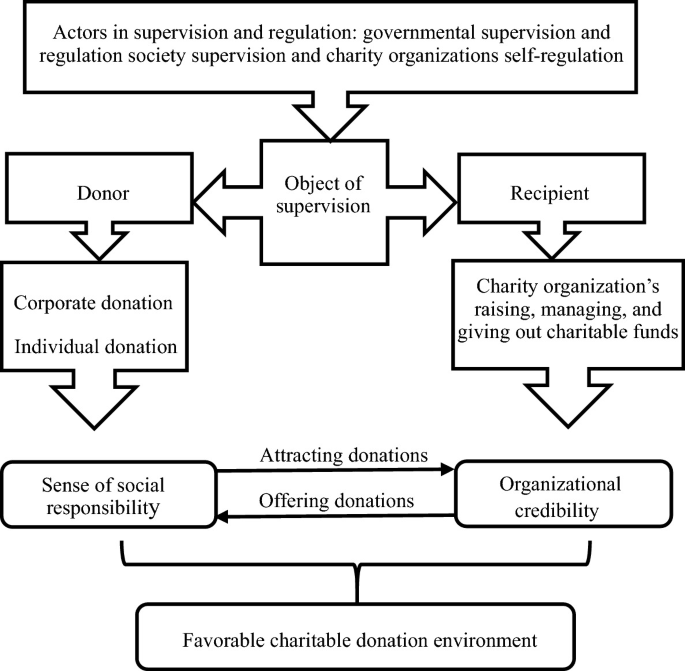
Mechanism of supervising and regulating philanthropy
Full size image
4.4.1 Governmental Supervision
The main means of supervision and regulation used by government agencies include formulating relevant laws and regulations, as well as supervising administrative enforcement of them. Generally, government departments practice supervision and regulation of charity donation activities by virtue of the authority of state laws and regulations and the coercive power of government.
4.4.1.1 Current System for Supervision and Its Performance
1.
Supervision by Laws and Regulations
China’s standards for managing enterprises’ participation in charitable donation and fulfillment of their social responsibility can be found in different laws, regulations, and documents, such as the “Contract Law of the People’s Republic of China” (1999), “Law of the People’s Republic of China on Donation for Public Welfare Undertakings” (1999), and “Enterprises’ Accounting Standards” (2007), as well as the “Circular on Strengthening the Financial Management of Enterprises’ External Donation” and the “Circular on Issues of Strengthening the Financial Management of Central Enterprises’ External Donation,” issued by Ministry of Finance in 2003 and 2009 respectively. Specifically, the articles concerned involve the requirement for enterprises to adhere to principles of voluntariness and sincerity in their external donations, formulation and implementation of the internal procedures for managing external donations, supervision of external donations by enterprises auditing (or supervising) agencies or financial management departments, etc.Footnote43 The purpose of these is to prevent disordered donation behavior by enterprises and to ensure their proper fulfillment of social responsibility. The management of central SOEs external donations should abide by the relevant provisions in “Some Regulations on Incorruptible Employment of Leaders in State-Owned Enterprises,” which emphasizes that donations by SOEs must be approved by institutions that perform the duties of state-owned asset contributors.
For the supervision and regulation of individual donation behaviors, provisions in current laws and regulations clarify the responsibility for those ill-intentioned donation behaviors such as fraudulent donations, “promising but not donating,” and “donating less than promised.” Article 188 in China’s Contract Law stipulates expressly that “In the case of a gift contract the nature of which serves the public interests or fulfills a moral obligation, such as disaster relief, poverty relief, etc., or a gift contract which has been notarized, if the donor fails to deliver the gift property, the donee may require delivery.”Footnote44 At the same time, a gift contract the nature of which serves the public interests or fulfills a moral obligation, such as disaster relief, poverty relief, etc., or a gift contract which has been notarized, cannot be canceled. The “Law of the People’s Republic of China on Donation for Public Welfare Undertakings” also provides definitely for legal liability the donor must fulfill according to his gift agreement. Current laws and regulations not only protect the donor’s rights and interests, such as the right to make free choices, but also require him to fulfill his obligation. The government’s supervision and regulation of charity organizations’ processes of raising and managing the public welfare funds are inseparable from the formulation and implementation of relevant laws and regulations. The existing “Law on Donation for Public Welfare Undertakings” and “Regulations on Foundation Administration” carry clear provisions for the specific proportion and orientation of the amount to be used in charitable donation property received by charity agencies, particularly emphasizing adherence to the purpose of the donor in using the property. Besides the provisions for direct supervision and regulation of the funds obtained by a charity organization, relevant laws and regulations also give the donor with the right to be informed on and to make suggestions regarding the donated property and protect the donor’s right to cancel and remove his donated property if it is used against the donation agreement between him and the charity organization. This is a way of conducting indirect supervision and regulation. Since 2011, there has appeared a new point to be supervised and regulated by the laws and regulations. Both the contents of laws and regulations issued by the state and legal documents issued by local governments have been emphatic in stipulating that charity organizations shall disclose relevant information to society. At present, the content of and responsibility for donation information disclosure are clearly stipulated in one law, four government regulations, four department regulations and normative documents and seven local regulations or normative documents in China.Footnote45
2.
Administrative Supervision and Regulation
The effect of laws and regulations must be ensured by effective administrative enforcement of them. According to the “Law of the People’s Republic of China on Donation for Public Welfare Undertakings,” in special periods such as serious natural disasters, donated funds directly received by Ministry of Civil Affairs, as well as local governments and their civil affairs departments, should be brought under the purview of government supervision and regulation. Within the civil affairs system, administrative supervision and regulation of the donated property can be carried out mainly by such means as special examinations, as well as disciplinary and auditing inspections and supervision. Supervision and regulation over donated funds received and used by charity organizations should be implemented mainly through the public administration of the charity organizations.
In the past several decades, the supervision and regulation of non-governmental charity organizations in China have been effected with annual inspections by governmental departments responsible for their registration serving as the central link. In this process, a non-governmental charity organization first submits its annual work report to the superior department in charge of its administration in accordance with relevant laws, regulations, and policies. Then, the department makes an initial examination of the report and put forth its opinion on the basis of the information available. Ultimately, the department which administers the registration of the organization carries out a comprehensiveness of all aspects to determine whether the organization passes or fails. The administrative supervision and regulation of donated funds is conducted mainly in the form of auditing charitable funds. State agencies that specialize in auditing and auditing agencies approved and set up by governmental departments, as well as their specialized auditors, are responsible for carrying out special or routine auditing of the economic behavior of charity organizations during the process of raising, allotting, and using charitable funds. In recent years, administrative control of supervision and regulation of charity organizations has been lifted step by step under the backdrop of the reform of the administration system. Since 2004, the reform allowing for a direct registration system has relaxed the restrictions on the registration and administration of charity organizations. When mobilizing social donations, the civil affairs departments no longer designate which charity organizations receive donations. Since 2011, the Ministry of Civil Affairs has started to plan to categorize social organizations engaged in public welfare and charity undertakings as public welfare charity organizations. Their supervision and regulation will be carried out on a unified basis by the Ministry’s Charity Department. The main contents of charitable donation under supervision and regulation include whether charitable fundraising behavior is standard and whether the public is informed of charitable donations and relevant financial affairs. Objects under such supervision and regulation do not include charity organizations such as Red Cross Society of China that are exempt from registration.
4.4.1.2 Factors Promoting the Government Supervision and Regulation Mechanism
1.
The Government’s Increasing Attention to Developing Charity Undertakings
The Report of the Seventeenth Party Congress of the CPC positions philanthropy as an important supplement to the social security system covering urban and rural residents, with an understanding of the absolute necessity of philanthropy in constructing the society. The Report of the Eighteenth Party Congress of the CPC further proposes that reform of philanthropy should be deepened and emphasizes that tax deductions and exemptions on charitable donations should be improved, supporting them to play active role in poverty alleviation. The Ministry of Civil Affairs has set up a special group for leading and coordinating philanthropy and a bureau for coordinating philanthropy and has released annual reports on the charitable donation in China from 2007 to 2013. 2011 saw the founding of the China Charity and Donation Information Center, which, with the support from civil affairs departments, has issued annual reports on charity transparency in China that are based on its surveys and investigations from 2011 to 2013. In 2013, as indicated by a series of documents represented by the “Annual Report on Government Information Disclosure in 2012” issued by Ministry of Civil Affairs, the government is striving to examine a system of social organizations’ public welfare information disclosure that combines administrative supervision and regulation with social supervision.
2.
Gradual Improvement of Rules and Regulations for Philanthropy
Informed by the practices of charities at home and abroad, a rigorous system of legal norms must be established for developing philanthropy. Such a system is the fundamental guarantee ensuring their healthy growth and orderly operation. China’s legislation concerning charities has accomplished considerable progress, with seven laws and regulations introduced, including the “Law of the People’s Republic of China on Donation for Public Welfare Undertakings” and the “Regulations on Foundation Administration.” As laws, regulations, and policies play an indispensable role in pushing ahead the development of charities, in the face of the fact that China has not formed a complete legal framework covering the entry to and exit from philanthropy, the evaluation, supervision and regulation of philanthropy, the delimitation and transfer of public welfare property rights, relevant financial investments, among others, the consideration of “Charity Law” (Draft) has been both on the agenda of legislation and under active discussion in China.
4.4.1.3 Troubles with Current Supervision and Solutions
Relative to social supervision and self-regulation, the government’s administrative supervision and regulation of philanthropy have stronger coercive force. However, the current administrative supervision and regulation, with its main form being annual inspection and assessment, still lack a complete system of laws, regulations and rules as a guarantee. It is difficult for government supervision to be exerted effectively. Additionally, there are still issues with the coverage, efficiency, and process of administrative supervision and regulation.
1.
Relevant Supervising Laws and Regulations Still to be Improved
China has yet to introduce any special laws on charity. Legal provisions for the supervision of donating funds and the behaviors of charitable organizations are scattered through various different laws such as the “Law of the People’s Republic of China on Donation for Public Welfare Undertakings,” “Regulations on Foundation Administration,” “Regulations on Administration of Social Organization Registration,” “Interim Regulations on Administration of Non-Governmental Non-Enterprise Unit Registration,” the “Contract Law,” and even management procedures formulated by relevant departments. Their overly general provisions lack the necessary oversight for specific links or controversial areas in the operation of charity organizations. For example, regarding supervising and evaluating charity organizations, concrete requirements on the bases or procedures for supervision and regulation have not been offered on issues such as related transactions and avoiding conflict of interest. The absence of detailed provisions in laws and regulations adds to the difficulty in enforcing supervision and regulation of donations. This is detrimental to coordination of relations between all interested parties, liable to lead to some blind spots in the enforcement and harm charity donation undertakings.
Additionally, there is a limited scope of applicable laws defining normative donation behaviors, it is impossible to effectively regulate the direct donation behaviors of enterprises and individuals and it is difficult to guarantee the right to know and choose the right of direct donation. It is not conducive to long-term participation in charitable activities and leads to the rights to know and choose in making charitable donations being difficult to guarantee, which are not conducive to long-term enthusiasm to take part in charity. To provide effective legal constraints for the supervision and regulation of charitable donation, it is imperative to set up uniform and concrete legal criteria, upgrade the legislation of the laws which empower supervision and regulation, enlarge the supervised and regulated scope of cases and further improve relevant links in legislation, so that the authoritative and effective support of laws and regulations can be truly guaranteed for the supervision and regulation of charitable donations.
2.
Lack of Objective and Complete Supervision and Low Efficiency of Audits
The main objects of administrative supervision and regulation are the large-scale public foundations. In China, generally, these foundations are sponsored by governmental departments or organizations closely related to the government that gain financial support from government departments. “Government-run” charities are subject to direct management by government departments, which are both their rule-maker and the judge, making it hard to ensure that administrative supervision and regulation of charitable donations is objective and effective. At the same time, charitable organizations for which government authorities regulate the disclosure of charitable information are still mainly foundations, societies and private non-enterprise units with independent legal personalities. The relevant regulations for private charitable organizations and special funds need to be clarified.
Currently, supervision and regulation of the charitable organizations’ operations of their funds are mainly conducted by auditing agencies through financial audits. As the traditional financial audit does not work for a specialized accounting system, the disclosure of donation information does not follow a uniformly specified pattern. Only relatively large foundations are capable of offering their standardized financial reports audited by a certified public accountant in accordance with the law, while some smaller charity organizations have low quality financial audits and lack standardized and normalized audit reports. Thus, it is hard for the forces of social supervision to effectively obtain information by reading audit reports.
The United States has more maturity in the uniformity of financial statements offered by charity organizations. Each year, charity organizations submit “Form 990,” a uniform annual statement to the federal Internal Revenue Service. That form not only applies to all American charity organizations but also can be assessed by an independent third-party evaluation organization. In view of this, in the future, the administrative supervision of charitable donations in China needs to ensure the effectiveness of charitable resources for public welfare services through the following: requiring all types of charity organizations to provide uniform and normal financial reports and entrusting competent audit agencies to audit them; intensifying law enforcement for supervision on the basis of full donation information disclosure; introducing a proper reporting mechanism for social supervision.
3.
Post-event Supervision is Dominant; Whole-Process Supervision and Regulation are Lacking
Currently, government supervision and regulation of charitable donations is usually conducted on an annual basis. Charity organizations or donating enterprises are required to annually review and examine their public welfare donations made in the previous year. Though relevant laws and regulations emphatically reiterate the definition of the illegal donations behaviors that violate regulatory requirements, yet punitive and preventive laws, regulations, and rules are still absent. Most of these forms of supervision are post-event supervision and lack supervision of donation activities and donations before, during and after the donation. From the confirmation of charity organizations tax exemption qualifications to the legitimacy of the fundraising process, and the location of charity assets, seamless supervision of relevant departments is required. The 2011 “charity fraud” of Wuxi’s Suntech sounded the alarm for regulatory oversight. After that incident, the China Charity Federation reflected on its putting “too much trust” in the donor. At the same time, this incident reflects the division of the daily supervision of relevant taxation authorities and business management departments, which is not conducive to ensuring continuous supervision of all links of donation.
The next step in improving the regulatory system requires the cooperation of registration authorities, business management departments, taxation authorities, and related functional departments. It will shift priority to tracking the entire process of donation behavior and motivations for donation, and change the supervision of simple evaluation to the combination of reward and punishment, so that supervision really plays a role in promoting charitable donation.
4.4.2 Social Supervision
In the area of social supervision, the government has in recent years used media technologies to establish information disclosure platforms, combined relevant evaluation and reporting systems and introduced public, media, and private third-party organizations to supervise charitable donations.
4.4.2.1 Existing Domestic Means of Supervision and Their Efficacy
1.
Public Opinion
The public can supervise as individuals. A considerable number of donors not only participate directly in the public welfare undertakings through their own donation behaviors but also continue to pay subsequent attention to supervising the allocation and use of their donated funds. In recent years, advances in information technology have provided the public with convenient paths to charitable information. This has tremendously promoted the growth of the philanthropy. In particular, as non-governmental donation fundraising forms such as collecting donations online are presently growing, it is easier for public supervision to be involved in charitable donation. Public supervision requires charitable organizations to actively disclose the flow of resources to the society, as well as the use and effects of these resources, revealing information necessarily and accurately. Thus, the supervision of public opinion needs to be combined with the self-regulation of charitable organizations, and it needs to be predicated on public oversight powers that are clearly defined by law.
2.
Media Supervision
The role of the news media in promoting philanthropy cannot be overlooked. Publicity from the mainstream media has long been an important factor in stimulating the public’s enthusiasm for charitable donation. At the same time, the media’s tracking of and attention towards charitable donations have played a powerful supervisory role on behalf of the public. Joining hands with charity organizations, the media have advocated the transparent operation of “micro-public goods” programs launched and run on the new media platforms such as Weibo (a microblog). They have successfully fortified the social credibility of programs such as Free Lunch for Children and Love Save Pneumoconiosis.
Under the backdrop of new media, social supervision tends to be realized in the following ways: undertaking professional inspection of the data and information of charitable organizations portals and guiding the public to take a more professional understanding of the situation for charitable donations; regularly publicizing and reporting charitable donation activities, the building of relevant laws, regulations, and policies, and information on charity organizations, exposing donation behaviors and processes which violate laws and regulations, answering questions asked by the public, and making up for loopholes in supervision. Through new media technology, the public can also spread and share the useful information that they have and ask questions, thus supervising the donation process.
3.
Supervision by the Third-Party Organization
The establishment of a transparency evaluation system has also promoted the social supervision of charity organizations. In 2013, Ministry of Civil Affairs issued the “Circular on Popularizing the Use of China Charity Information Platform,” which mandated more effort to speed up construction of charity information. At present, China Charity Information Centre (http://www.zmcs.org.cn/), China Foundation Center (http://www.Foundationcenter.org.cn/), and the Union of Self-Disciplinary Organizations (USDO (http://www.chinausdo.org/)) each has developed their own system of charity organization transparency indicators (see Table 4.6).
Table 4.6 Charity transparency evaluation indexes in China (excluding Hong Kong, Macao, and Taiwan)
Full size table
4.4.2.2 Factors Favorable to Promoting Social Supervision
1.
Public Concern and Use of New Media Technology
The occurrence of a star enterprise committing charity fraud and the Red Cross Society of China’s crisis of credibility reflect current problems with the supervision and regulation of charitable donations. They also strengthened the attention paid to charitable donations by forces of social supervision and the general public’s appeal for supervision. The development of many new media platforms such as web portals, blogs, micro-blogs, WeChat, and social networking sites have brought about new ways of making charitable donations and also new means of supervising charitable donations.
2.
Increase Strength of Non-governmental Supervision
The gradual growth in the public’s participation in charitable donation is embodied not only in increases in charitable donation volume and instances of charitable donations, but also in the increasingly stronger appeals for the right to be informed and supervise charitable donations. The public is growing more familiar with ways to access information on charity organizations and its capability to collect and screen relevant charity donation information has continued to grow. Additionally, it has become easier for various types of public interest organizations and government agencies to use web portals to conduct public investigations into charitable donations, from which they can obtain a large number of opinions from members of the general public on charitable donation supervision.
4.4.2.3 Main Difficulties and Challenges
1.
Absence of Independent Third Party Supervision and Regulation
In China the new media and public's supervision of the flow and process of charitable donations is relatively weak and members of the public have little information on where their donations go. This calls for supervision conducted by the truly independent third parties. Currently, the human resources and operating funds of the “third party” agencies depend on administrative departments and self-regulating charity organizations and lack support from truly independent social organizations. This deficiency makes it difficult for them to carry out independent and objective supervision and makes it easy to call their independence into question.
2.
Challenges Facing Objective and Truthful Media Supervision
As one of the main channels by which the public obtains information on supervision, the news media should take an objective and fair stance in reporting and disclosing information concerning charities. New media, with its strong capacity to publicize and mobilize, may distort true information. Much of the news media’s publicity and reporting will inevitably be influenced by certain media figures’ pursuit of sensational effects. In reality, once there a hot event attracts the public’s attention, the media will be stimulated to “make news” in order to draw eyeballs. On the other hand, when facing strong economic enticement or being under strong political pressure, the media may even become an accomplice to or a protector of scandalous charitable donation behavior. Thus, it must be clear about the significance of social supervision for philanthropy and make full use of its own advantages to turn public attention to charities towards the supervision of charitable donations, so as to elevate public participation therein.
4.4.3 Self-Regulation of Charity Organizations
Charity organizations’ capability to self-regulate is also an important factor bearing on their credibility. On the basis of their information disclosure platform, organizational self-discipline can be realized through managerial means by internal leadership and also through introducing relatively independent industry oversight.
4.4.3.1 Existing Means of Self-Regulation and Effects
1.
Supervision by Charity Organization Boards
A charity organization’s board of directors is responsible for part of its self-regulation. Through regular meetings, it hears how the donated funds are used by the executive departments, guides the organization in making self-examinations and self-corrections with regard to the property received in donations. It is mainly responsible for maintaining the value of the organization’s internal funds, reviewing the annual revenue and expenditure budget, and guaranteeing scientific assessment and decision-making.
2.
Self-regulation Through Information Disclosure Platforms
After 2011, Chinese charitable organizations generally strengthened their self-regulation in concert with the development of internet technology. The official websites of the China Red Cross Foundation, the China Youth Development Foundation, Free Lunch for Children, and the One Foundation have received extensive public attention. At the same time, a new platform for interaction with the public was created, and annual financial audit reports were published online.
3.
Introducing “Third Party” International Supervision
The initiative of the China Youth Development Foundation led to the founding of the “Hope Project National Supervisory Committee.” Members from governmental agencies, news media, donor representatives, and the department in charge of Hope Project, among others fulfill the function of social supervision for the project. In 2012, the Social Supervision Committee of Red Cross Society of China was established. It serves as a third party supervising the work of the Society. In June 2013, the Social Supervision Committee for Guangzhou municipal charity organizations was established. Staffed entirely by non-public servants, it is responsible for making work plans, choosing the key items to be audited and key programs, writing supervisory reports and their releases, etc.Footnote46
4.
Industry Supervision
Some charity organizations have joined hands and launched industry-based self-regulatory supervision. For example, they have financed the establishment of an independent portal for the statistical publication of data on charitable donations and assistance and formulated their own self-regulating ordinances to intensify the supervision of charity organizations and standardize their donating, receiving, and assisting behavior, as well as elevate their awareness of self-regulation.
4.4.3.2 Forces Pushing for Self-Regulation of Charitable Organizations
The breaking of the “dual management” barrier has lifted limitations on traditional administrative management and the government has sped up the transfer of its functions to charitable organizations. The introduction of many regulations, rules, and policies contained in such new documents as “Regulations on Foundation Administration” (2004), “Procedures of Publishing Foundation Information” (2006), “Some Rules on Standardizing Foundation Behaviors” (2012), and “Guide for Public Welfare Charity and Donation Information Disclosure (Draft for Comment)” (2011) has step by step provided a basis for requiring charitable organizations’ transparency. At the same time, due to a series of donation scandals, more charity organizations have begun to self-reflect and become aware that only by improving standardized practices in recording their receipt and usage of donated funds and bettering their information disclosure can they reduce the possibility of critical incidents that damage their own credibility and enhance their own “immunity” to donation misconduct.
4.4.3.3 Current Deficiencies and Challenges
Although some information disclosure platforms have been set up, according to the “2014 Report on China Charity Transparency” issued by the China Charity Information Centre in October 2014, only 28% of 1,071 respondents were satisfied with information disclosure by Chinese charity organizations.Footnote47 These has been a gap between the initial efforts of some charity organizations’ web portals dedicated to information disclosure and their continued efforts to maintain them, with many delays in information updating. There is still much room for improving the validity, reliability, and interactivity of the information offered on these platforms.
At present, the content of the information disclosed by the charity organizations focuses on their organizational charters and annual work reports, while in other aspects only an inadequate amount of information is made public. There is little external constraint for information regarding associated transactions, project implementation, and beneficiaries, resulting in self-discipline lacking in depth and breadth, which is also disadvantageous to effectively conducting administrative supervision and regulation, as well as social supervision.
A report by China Charity Information Centre on information disclosure by public foundations indicates that the percentage of foundations which offered annual reports or annual financial reports was rather low.Footnote48 Many organizations failed to produce any financial reports that accorded with international standards. They also failed to offer clear information in their annual reports on such issues as the source of their funds, composition of their projects, how they made payments, and whether they had independent auditing.Footnote49 The Research Report of China Foundation Transparency Development (2014) jointly put out in 2014 the China Foundation Center and Incorruptible Government and Governance Research Center of Tsinghua University further points out the widespread existence of problems with the information disclosure such as inadequate information and delayed disclosure. In Beijing, 96% of the foundations have made their financial information public, but only 8% have revealed where their funds went.Footnote50 These problems are attributed to the lack of a mandatory requirement that these organizations be subject to a rigorous and unified external assessment, and also the absence of a feedback mechanism to provide the results of assessments to non-governmental organizations.
4.4.4 Establishing a Multi-dimensional Supervisory and Regulatory System for Philanthropy
Various supervision and regulation mechanisms are highly complementary. How to bring into full play the unique functions and positive influences of different means of supervision while avoiding institutional defects? This is important issue to improve the regulatory and supervisory mechanisms for charitable donations. On the whole, efforts should be made to establish an integrated multi-dimensional system of supervision and regulation. In building that system, the following points should be emphasized:
First, the formulation and improvement of charity laws and regulations are a necessary precondition for the supervision and regulation of charities and also an important guarantee for preventing problems in supervision and regulation. Legislation should establish step by step a sound system of relevant laws and regulations to endow the relevant governmental departments with the power to conduct administrative supervision and regulation and to endow the third party supervisory agencies with independent legal status, thus maintaining the legality of those supervising donations. Considering the changed charity donation environment, provisions for charity organizations’ donation information disclosure, associated transactions, avoidance of conflict of interests, and internal governance should be added to the articles of laws and regulations. When formulating or improving the laws and regulations concerned with relevant industries, more definite and detailed articles should be provided for the industry self-regulation standards as well as media standards for supervising behavior, thus eliminating blind spots in the current supervisory and regulatory process.
Second, the interface between various links in the supervisory and regulatory process should be strengthened and the cooperation of supervisory and regulatory bodies should be advanced. First, laws and regulations empower the government to conduct administrative supervision and regulation, with administrative supervision and regulation as the concrete execution of legal supervision and regulation. Second, the governmental departments concerned with administrative supervision and regulation should make public their relevant work and accept both administrative supervision and supervision by the society and the public. Lastly, the self-discipline of an organization requires it to disclose on its own internal information on its donations and accept supervision by the government and society. Governmental supervision and regulation, social supervision, and organizational self-regulation are the three main links of the system to supervise and regulate philanthropy. However, in the future other forms of supervision and regulation may arise and additionally the mutual support and cooperation between different links should not be neglected which is significant to developing a multi-dimensional system of supervising and regulating donations.
Third, a system of core indicators for charity donation transparency should be determined and a diversified system of assessment subjects should be fostered. The evaluation of charitable organization transparency lays the groundwork for other supervisory links. The existing three main systems of indicators (CTI, FTI, and GTI) have served as significant tools for the evaluation of charitable donation transparency. However, on this basis, it is necessary to comprehensively consider the purpose of the organization and the needs of society to further filter out relatively uniform and concise “core indicators.” When formulating the criteria for assessing charitable donation transparency, differences in the nature of different charitable foundations should be considered and the criteria oriented towards public foundations should be upgraded. The collection and evaluation of the data needed for assessing charity donation transparency depends on the participation of all relevant subjects, including specialized assessment agencies, accounting firms, employees in charitable organizations, people from the same industry, and beneficiaries. It also depends on various methods such as the records and archives of organizations, on-the-spot observations, and impromptu interviews.
4.5 Community Promotion Mechanism
In a community’s donation activities, participation, incentive, constraint and publicity mechanisms all play an important role. In 2006, the present project’s research group, conducted an empirical survey of the charity donation activities held in a village community located in Shandong Province through in-depth interviews, participating in observation and literature collection, among other methods. The interviewees included three types: the village CPC branch secretary, the deputy secretary, an accountant, and the cadre in charge of publicity (4 people); villagers (18 people, who engaged in trade or farming work, or were employed in the village enterprise); villagers of other villages (6 people, who were employed in the village enterprise). As shown by the field investigation, the village community members’ roles in the charity donation activities held by the village and their public consciousness thereof are changing and a favorable community mechanism means much to elevating donation consciousness and behavior.
4.5.1 Introduction to the Case
In the present case, XZ Village is located in PY County, JN City, SD Province, covering an area of 3.4 km2, with 3520 villagers in 1054 households (as of 2005) and farming area of 4200 mu (roughly 280 ha). The village’s uniqueness lies in its public welfare undertakings, particularly its distinctive charity donation activities, making it a widely known “star village” and a famous “charitable village.” The villagers of XZ Village have organized charity donation activities on a significant scale since 1992. Up to March 2006, this village of 1000-odd households has donated RMB 3.04 million to itself and some other villages. The highest number of households involved in a donation activity was 903,Footnote51 meaning that over 90% of its households joined in. Economically speaking, XZ Village is not a wealthy rural community. The annual per capita output value of the village in the four years from 1992 to 1995 was only a little more than 1000 yuan; by 1996, the figure had increased to 2300 yuan. From 1997 to 2004, its annual per capita output value was 3000-odd yuan and the year 2005 saw it rise to 4217 yuan. A village at an intermediate level of economic growth in SD Province, it ranks among the top in size and volume of charitable donations.
Concerning the orientation of its donations, 83.18% of XZ Village’s donated resources have gone to related beneficiaries such as its villagers and the public goods and public welfare activities of the village. 6.95% have been given to unrelated beneficiaries, for example the Southeast Asian tsunami in 2004 and China’s program to develop its western regions, and 6% has been spent in common spheres where there is a benefit for both its villagers and the villagers of other villages, for example, the township high school, where some children go for schooling.
Regarding the forces driving donation, there are two types: those based on internal plans and those based on external influence. A donation made for any purpose spontaneously, or through organizing efforts by a community or a department and that is concerned with the community or department itself is driven by an internal plan. If the reason for donation comes from outside of a community or department and it is brought about by publicity from government, charity organizations, or the mass media, then the donation is driven by external influence. 90% of the donations in XZ Village are driven by internal plans, with only 10% driven by external influence.Footnote52
In terms of the mode of donation, we can divide the donations of XZ Village into three types: purely spontaneous, organizational, and a combination of the two. Villagers making spontaneous donations based on their own judgment to other villagers or households in need of assistance fall under the first type. Donations made for various reasons through appeals and mobilization by the village’s administrative organization are of the second type. Donations which are made when villagers are willing to donate and the village makes corresponding arrangements belong to the third type. Of all XZ Village’s donations, the number of the purely spontaneous donations accounts for a very small percentage. Only those made on some special occasions such as Teachers’ Day and Seniors’ Day and certain cases such as households hit by disasters or serious diseases are of this type. A large number of donations belong to the other two types, with over 90% of the total being organizational, including those made to the public welfare undertakings of other villages, in particular to the public welfare (public goods) undertakings of the village itself and its neighboring villages.
Voluntary donation activities that engage the people have played a considerable role in alleviating the difficulties of some families in difficult circumstances, closing the rich-poor gap, and in making up for the deficiencies in the current social security system. They have also had multi-dimensional significance for enhancing the village’s image, reconstructing the social order of the village, nourishing the villagers’ common values, promoting community solidarity and integration, and elevating community cohesion.
4.5.2 Dynamics and Dimensions of Community Promotion Mechanism
The study of charitable donation behaviors is usually conduced from two theoretical perspectives. One of them emphasizes individual demand, regarding donation as active behavior of an individual driven by internal motivation. The difference among the scholars studying from this perspective lies in that some of them place more emphasis on the self-care motivation, i.e. “for the satisfaction of their own mind,” while some others tend to stress the altruistic motivation, i.e. “for helping others.”Footnote53 The other perspective gives salience to “relationships,” holding that since an individual lives in a society, their behavior must be under the influence of social factors and other people. For example, Alan Radley and Marie Kennedy (1995) are of the opinion that whether an individual donates depends on their motivation, the social norms which control their behaviors, and certain situational conditions. As found in their study, the features characterizing an individual are not a significant factor, while their “involvement in the society,” that is, their relationship with the society, is the most significant.Footnote54 Results from a study of residents of four cities in Mainland China support the above theory, that is, that the charity donation behaviors of Chinese people are strongly passive, having little to do with individuals’ internal demand, but depending highly on the donation raising activities organized by their work units or communities.Footnote55 On the rural side, the village community is the main area where villagers live and move and the occurrence and development of their donating behaviors are both closely related to their community. On the basis of our survey of XZ Village, we find that though ethics and consciousness can offer some explanation of the villagers’ donating behaviors, more important are the existence of four major mechanisms in the village which have exerted a tremendous impact on the villagers’ donation activities.
4.5.2.1 Participation Mechanism
Charity is a shared social undertaking for public welfare that includes both the wealthy and all members of society who are capable of offering financial assistance to others. That both the wealthy and also other members of society participate in charity is the intrinsic requirement and necessary condition upon which charity grows and flourishes.Footnote56 Since the inception of its charity donation activities, XZ Village has advocated universal participation by villagers, which it has made into both the base and a prerequisite for these activities. Any villager, whether man or woman, old or young, rich or poor, high or low in their position or power, will get as much support as possible from the village so long as they are willing to donate. This broad participation is shown not only in the construction of the village’s public goods and the assistance to families in difficult situations, but also in participation in social public affairs. For example, when the village needed to build its public facilities such as its kindergarten, Hall of Righteousness, and Street Plaza, over 80% of its households donated. When the Indian Ocean tsunami in 2004 and the catastrophic floods in South China occurred, more than 80% of households donated. This level of participation and the volume of donations were both extremely rare among villages in SD Province.
According to the previous theories, when it comes to community participation, the behavior of participants follows a clear law. The upper-middle strata of community members are relatively more enthusiastic about community affairs, for they are more empowered to engage in them and to participate in the decision-making process. The lower strata are less empowered to engage and participate in the decision-making process concerning community affairs, so they show less enthusiasm. Of course, when an affair greatly concerns all groups of community members, each one of them will be more enthusiastic to engage and participate in. The large scale of participation, large number of participants, and high extent of participation that are characteristic of the charity activities held by XZ Village have much to do with the village’s unique participation mechanism.
The survey found three salient aspects of XZ Village’s participation mechanism. First is voluntary participation. Differing from the administrative and forced donations activities (such as deductions of salaries) in some places, XZ Village emphasizes the voluntary principle when organizing its donation activities. On the basis of its own actual conditions, a family decides how much it will give. Every time the village committee mobilizes villagers to donate, it repeatedly emphasizes the participation of volunteers and that the participation is more important than the amount given. The voluntary mechanism stimulates the ardency of the villagers, who see donation as a way of helping others and joining in public activities, rather than a forced burden they have to passively carry. Second is convenient participation. To participate in donations, one has to pay an economic cost, but when there is no convenient and effective platform available, donors’ giving behaviors are further restricted. That is why XZ Village has built a whole set of donation raising mechanisms that facilitate villagers participating, collecting their donations in a concentrated way, and reporting them in timely fashion. Every time a donating initiative starts, the Hall of Devotion, a village center with educational significance and frequented by the villagers, is designated as the donation site. Whenever the villagers get information on the donation program, they will arrive at the site within the required time. We have found in our surveys of other communities that, actually, there is popular demand among the people to participate in charity, but there is no convenient and reliable platform accessible to them. This results in difficulties in carrying out donation activities. Third is meritorious participation. In XZ Village, the villagers take their participating in donations as a way of joining public activities and see donations to public welfare undertakings or to distressed groups of people as an opportunity to show their loving heart. This is the direct result of the culture of giving which encourages donation and regards participating in donation as meritorious that has been long-nourished in the village, as well as an atmosphere of providing assistance. Many villagers said, “Through our meager donations either to our fellow villagers or to those people in other provinces or even other countries who need them, we can give a hand so that they can tide over their difficulties, for which we feel happy. At the same time, it purifies people’s minds and reinforces the value of their existence. If we donated little or nothing, then we would have psychological uneasiness.”Footnote57 It is through the voluntary (not forced) participation mechanism, convenience of participation (no need to go out of the village), and meritorious participation (receiving praised) that the number and level of donations have been higher in XZ Village than other villages.
4.5.2.2 Motivation Mechanism
Charity is an undertaking imbued with love, maintained by morality, and the willingness to give without any expectation of taking. These are the prerequisites and basic requirements for donor participation. However, different incentive mechanisms directly influence donors’ giving behaviors. To remain anonymous represents a supremely lofty realm of philanthropy, yet this should not be required of all donors. Actually, in the contemporary society, it is hardly possible for many to give that way. Appropriate spiritual rewards and material incentives are not just allowable, but also necessary, for the effect they produce is usually inestimable.
The village committee of XZ Village has attached importance to donation incentives and established step by step an operating system which incorporates both spiritual and material incentives that are mutually penetrating and supporting. There has been a saying among the villagers, “Fame brings benefit and benefit brings fame.” When a villager does something good and contributes to the villagers as a whole, the village not only has their merits broadcast or put on the TV and made known to other villagers, but also rewards them so that they will not suffer a loss. To carry forward what is righteous, commend model villagers, and encourage healthy trends, XZ Village has constructed a Hall of Righteousness, where village deeds such as righteous and courageous actions, respecting the elderly, caring for the collective, and taking pleasure in helping people are exhibited through objects, pictures, and texts, vigorously advocating a new cultural trend. All public facilities constructed by donated funds are matched with tablets inscribed with the names of the donors erected beside them for the purpose of honoring and remembering those donors.
The most illustrative case of XZ Village blending spiritual and material stimulation effectively is its activity to appraise and select a “five-virtue family.” In carrying out it, the village adopts the method of each household recommending the names of a certain number of candidates. If any of the members of a recommended household is found to have violated the village agreement and rules, the household will be disqualified for the appraisal and, beyond that, two votes will be taken away from the household that recommended them. This means has been used to prevent any votes based on favor or special relations and has not only enhanced the villagers’ sense of responsibility and fairness, but also ensured that the winning households are truly elevated. To encourage efforts to win the honor of “five-virtue family,” the village has invested 750,000 yuan to set up its award fund for the “five-virtue family” program. Each year it also hangs glorious plaques for the “five-virtue family” households and presents them with prizes and certificates. If a household wins the honor of “five-virtue family” for four consecutive years, it will be rewarded amply. The prize the “five-virtue family” wins is not cash, but rather stock in the collective enterprise of the village, which they then receive dividends from annually. Moreover, according to the rules of the village, when a “five-virtue family” household builds new rooms it will get an award of 40 thousand bricks (worth 4000 yuan). Corresponding to new social and economic developments, the village has kept readjusted the conditions for evaluating and selecting “five-virtue family” households. For example, in the early years, the conditions emphasized of social morality and family ethics such as abiding by laws and disciplines, respecting elders, harmony among neighbors, being industrious and thrifty in household management, birth control, and transforming outmoded social customs. Later, it prioritized enhancing the quality of family members, pursuing wealth through scientific and technological means, and developing the collective economy, regarding the contributions to the collective and altruistic merits as the principal conditions. If a villager donates money to those in difficulty or to public welfare undertakings, he or she will be awarded a certain sum as a prize, which is also be given in the form of the enterprise stock that is entitled to receive dividends. The director of the village committee briefly sums up the incentive mechanism this way: “Let those caring for the collective and taking pleasure in contributions be awarded in spirit and material and let those disregarding the overall situation and harming others to benefit themselves receive no benefit at all.”Footnote58
The charitable donation mechanism of a society should turn the spontaneous donation behavior of donors into the normal state of affairs. The emphasis on donor behavior and incentives for donation (including keeping standardized records, conferring certificates, and donors having the right to be informed of the results of their donations), as well as effective spiritual encouragement and suitable material rewards, are all important, for they can ensure that the donors, obtain satisfactory returns after they donate, an important mechanism for the growth of charity.
4.5.2.3 Constraint Mechanism
Given that charity belongs to a social domain defined by morality and voluntary action, a sound supervision and constraint mechanism with symbiotic self-discipline, mutual discipline, and external discipline is a basic guarantee for the healthy development of charitable undertakings.Footnote59 In spite of the common features of charities, different cultural backgrounds, degrees of development of public welfare undertakings, and economic and political environments call for different development patterns for different countries and regions’ systems of supervision and constraint system.
The sustained practice of charitable donation in XZ Village can to an extent be attributed to a long-established institutionalized and public opinion-based social constraint mechanism. Regarding institutional supervision and constraint, XZ Village adopts completely transparent and institutionalized practices. First, donation activities are managed strictly. Each time the village launches a donation initiative, the village committee forms a special work group responsible for strictly managing the entire process and making sure that the accounts are clear, and the records are accurate. After the donation activity, statistical reports are made known to the public in a timely fashion so that they can be monitored by everyone. Second, financial information is regularly made public. The information subject to disclosure involves the balance of payment position of the village’s enterprise, the situation of the public welfare facilities funded by villagers that are under construction, voluntary labor services work, village awards to volunteers, application for and approval of status as a “household enjoying five guarantees,” and impoverished households’ applications for assistance and the approval of those applications. All of these are made known to the villagers through the village bulletin board. Third, a supervision mechanism is set up for mass participation in public affairs management. In XZ Village, both the criteria for evaluating and selecting “five-virtue family” households and the results are determined by all the villagers. The process of handling neighborhood disputes and immoral conduct is audio-recorded and broadcast, with calls for villagers’ discussion and comment. Villagers are engage in full discussion of village rules and agreements to be introduced and various issues of the village-level “legislation” to be decided. They must reach consensus before rules, agreements, and issues are implemented under their supervision. Village forums and question-and-answer meetings of village cadres are held for repeated discussions and extensive collection of the villagers’ opinions on the major issues concerning the rights and interests of all villagers. Thanks to such series of measures and practices, a new pattern of self-governance and democratic management has been developed in the village—every one of the villagers is both a practitioner and a receiver of management and supervision. Fourth, the system of “villagers evaluating cadres” has been established. Public activities such as donation in rural areas have much to do with the thought and behavior of the community leaders. When judging whether a cadre is competent or not, what should be considered is not only their capability of performing their duties, but more importantly their attitude towards accepting public supervision and their own self-discipline. Thus, XZ Village has established an entire set of systems for “villagers to evaluate cadres.” The villagers are empowered to: first, decide the criteria for evaluating the village cadres; second, evaluate their performance; third, assess their treatment, and, fourth, determine their award grade. The outcome of this “voting for trust” is that the villagers are willing to respond to the village’s call for donations, and believe in the righteousness and value of the donation activity. Seen from an organizational angle, the open and transparent operation of the institutionalized and standardized mechanism for supervision and constraint boosts the operational efficiency of community based public activities by removing the information barrier between the village cadres and ordinary villagers and at the same time deterring behaviors which harm public standards and public welfare undertakings.
At the level of public opinion supervision, the mutual constraint between acquaintances and the public pressure existing within the village have also contributed greatly to donation activities. A rural community is a small society of familiar relationships. Blood relations, marriage-based relations, and clan relations cause close connection and interactivity among the community members. In the narrow space of the community, any behavior is under the supervision of others’ views. The donation activity is also under the influence of these relations and space. XZ Village has advocated for the transparency and openness of donation information. The names of the donating families and the donated sums are made public on a notice posted on the village’s bulletin board and in the media. Additionally, they are printed as detailed reports and sent to all households so that the donation information of every household is clear to all. This high information transparency and mutual informing among the households constitute by themselves social supervision or a realm of public opinion. Even when one is unenthusiastic and unwilling to join in the donation activity, they have to give up that idea under the pressure from inside the village as part of a face-to-face society. This point provides evidence for Milton Friedman’s view that “I am distressed by the sight of poverty; I am benefited by its alleviation; But I am benefited equally whether I or someone else pays for its alleviation; The benefits of other people’s charity therefore partly accrue to me. To put it differently, we might all of us be willing to contribute to the relief of poverty, provided everyone else did. We might not be willing to contribute the same amount without such assurance. In small communities, public pressure can suffice to realize the proviso even with private charity. In the large impersonal communities that are increasingly coming to dominate our society, it is much more difficult for it to do so.”Footnote60 In our survey, we heard the villagers say “What I am afraid of is not the village cadres but the three thousand people (i.e. my three thousand fellow villagers).Footnote61
4.5.2.4 Publicity Mechanism
Regardless of the era, mutual assistance and spontaneous donation has never stopped, yet donation activities with considerable results and scale have usually been related to organizational mobilization. In fact, both large-scale social donations to disaster-stricken areas and people and also small-scale donations within a work unit or a community have much to do with mobilization strength and means of publicity. As the organizer of XZ Village’s donation activities, the village committee is responsible for the work of publicizing the village's donations. All committee members ranging from the director to the cadre in charge of the village publicity center have treated the publicizing donations as the basis of donation activities. Taking into comprehensive consideration the village’s tradition and the current conditions of state, society, and the village itself, they have probed guiding the public opinions in a multi-directional manner, sought diversified means of publicity, and highlighted the contents of paradigmatic cases, so as to elevate the villagers’ conception of charity and commend their charitable behavior.
Firstly, tapping the resources of traditional morality. XZ Village boasts a time-honored charity history and has cherished the traditional virtue of mutual aid and taking pleasure in donating. According to historical records, “XZ Village is the ridge supporting the mountain, the bank preserving the water, and the native place of the divine bird. The residents in it are filial and sincere and their children carry forward charity and inherit the virtue, leading a self-less life”Footnote62 is inscribed on the Li Yun Tablet erected in the third year of the Xianheng reign period under Emperor Gaozong of Tang (672 CE). XZ Village has inherited the virtue of charity and moreover it has extended it to “alleviating poverty and giving financial help, accumulating merits and pursuing goodness.” To educate the villagers and carry forward the XZ charity culture, the village has built a bronze statue symbolizing filial piety and sincerity in its central square that aims at fortifying the villagers’ inheritance and identification with charity tradition. To set charity examples for the villagers to know and follow, as well as to nourish their charity participation consciousness, a Hall of Righteousness and Hall of Devotion have been constructed from the funds invested by the village and donated by the villagers. It has many pictures of many domestic and international philanthropists such as Rulun Huang and Bill Gates, as well as written records of their merits. Charitable deeds that villagers have conducted in the village or other areas and contributions that people from other places have made to the village can both serve as the “entrance tickets” to the two halls of honor.
Secondly, transmission through community media. XZ Village has attached importance to using various kinds of community media to publicize donations. Since late 1980s, the village has had the speeches of village cadres, the meetings of village representatives, and village cadres’ dialogues with villagers in their home visits audio-recorded and broadcast repeatedly. In 1992, the village built a closed circuit television system and began to broadcast village news mainly including village cadres’ speeches, villagers’ suggestions, and readings of letters from villagers for ten minutes each day. We found in the survey that most villagers have developed the habit of watching the village news TV program. Every time a donation activity is held, all the warm-up publicity, activity process, the donation results, and the activity summary are broadcast on the village media and villagers are informed of them as soon as possible. Through these efforts, an effective information platform is built for villagers joining in the donation activities, and a reliable window also is provided for all villagers to know everything concerning the village’s donation work.
Thirdly, soliciting writing from the villagers. To encourage the villagers to participate in public activities, care for the construction and development of the village, and enhance their own quality, XZ Village launches regular activities of soliciting writing or letters from the villagers. Writes must point out the real names of both those who bring credit the village and those who bring shame to it. All writing is read aloud by the writer on the village’s TV station and good writing receives considerable reward. The process of writing, reading, and evaluating them is actually a vivid and concrete process of publicity and education.
Fourth, minding the art of good publicity. The effort to raise charitable donation is a beautiful public welfare undertaking. However, in the present age where material civilization has advanced substantially, it is not popular in many places. This is directly caused by inadequate efforts at charitable publicity. Some charitable publicity programs are not started on the right occasions, fail to provide proper reasons for donation, and do not stress the direct relationship of the art of publicity. However, in the case of XZ Village, in its publicity activities, it has laid emphasis on timing of publicity and the art of mobilization. First, it avoids empty talk, big talk, and such slogan-like things. Second, it gives detailed clarifications of the purpose, aim, content, use, catchphrase, and date of a donation initiative. Third, it tries to seize the opportunities to conduct charitable publicity during typical disaster relief or poverty alleviation events with major impact. Fourth, it reports in timely fashion typical cases of good deeds and merits, fortifying the climate of respecting the good and benevolent and remembering meritorious deeds. To quote some words from a TV speech delivered by the deputy director of the village committee in March 2016 when calling for the villagers to make contributions to found the village charity fund, “The CPC Central Committee and State Council have put forward constructing a harmonious society of China and, to construct a harmonious society, various regions across our country have founded their charity foundations. In our village, through donation activities across years, all our villagers are strongly conscious of devotion and have reached a consensus. Each year, among the families of our village, several dozens of villagers fall victim to some serious diseases and their families therefore fall into financial difficulty. Additionally, there are also some families suffering from natural or man-made disasters. These families need the warmth from the big family of our village and all of us should take a positive part in helping them. As considered and decided by the village’s CPC branch committee and the village committee, we will conduct an activity of showing loving heart and making selfless donations. … In the past, our donations for public welfare undertakings and our erecting the monument carved with the meritorious deeds were of both realistic and economic significance, as well as historic significance, which would be passed down to the future generations and written into history. This proposed activity of showing loving heart and making selfless donations will be more of value of life, for the value of life is also in devotion.”Footnote63 In only two days after that activity was launched, RMB 177,000 was raised in contributions to the fund for assisting families in difficulty. The efficient and effective charitable publicity removes the villagers’ misgivings regarding their donations and elevates their conception of philanthropy. Thus the village has gradually developed its own charitable culture featuring all the villagers engaging in donating behavior with the self-consciousness of serving others.
4.5.3 Features of Community Charity Donation
In a society, charitable donation occurs concurrently both in its urban and rural areas which are different in many aspects. As far as the current situation of charities in China is concerned, regarding the diversity of charity organizations, the availability of charity resources, or the pervasiveness of charitable behavior, the charity activities organized in rural communities are different from those in the urban communities. The charity activities held in XZ Village reflect to some extent the features of the charitable donation in rural communities.
4.5.3.1 Unification of Mutual Benefit and Public Interest
In terms of the orientation of benefits, charitable donation is non-profit or altruistic, and in a broad sense aimed at public benefit. However, as found in the survey, the public welfare orientation of the rural donation activities is, due to the limitation of boundaries, different in degree. If the beneficiaries of a village’s donations are mainly its own villagers, such behavior can be termed as a mutually beneficial behavior, while if the beneficiaries are the people from society at large, it can be termed as public welfare behavior. In terms of such a distinction, the donation behaviors of XZ Village actually reflect the unity of mutual benefit and public welfare.
The charitable activities of XZ Village were at first held among relatives, friends, and acquaintances in the village, in other words it was mutual assistance by the villagers. Donors were more inclined to donate to their own relatives and friends or their fellow villagers. This practice is referred to by academics as the “neighborhood effect” of charity. Gongcheng Zheng mentioned when studying Chinese donation activities that in traditional Chinese ethics, charity behaviors follow a circular law, that is, there is a far or near, close or distant relationship with the donor. As the traditional Chinese mentality prioritizes the close before the distant and the near before the far, if one, regardless of relatives, aided those other than his blood and marital relations, he would be considered abnormal. Also, if one did not help the impoverished or struggling people close to him, but rather gave his hand to impoverished or struggling people from other places, he would also be considered as abnormal. This way of thinking may be backward, but is conventional to the Chinese.Footnote64 For a long time, XZ Village’s own villagers were the main beneficiaries, with donations targeted at assisting struggling families in the village and funding construction of its public facilities and services. However, as indicated by the use of donations since mid-1990s, its charitable activities no longer aim to benefit the own community itself, but rather go beyond that and, within their own means, provide help to the victims of catastrophic disasters domestically and even abroad. These behaviors are more in accordance with the philanthropic concept advocated in modern society, for the transcendence of modern charity over traditional charity is embodied in that charity does not mean the alms given by the wealthy to the poor, but rather the citizens of the entire society autonomously organizing themselves and doing what they can for others. That charity is not limited only to poverty alleviation and help for the handicapped, but rather expanding the various undertakings aimed at enhancing the quality of people’s livelihood and bettering the living environment. In pursuit of charity, one should not be limited by their own narrow space, but, keeping society at large in mind, embrace the world with universal love.
4.5.3.2 High Degree of Dependence on Village Grassroots Political Power
Differing from traditional charitable ethics, modern charitable behavior does not mean an individual doing good for another individual, but rather a socialized and organized form of behavior. In urban communities, various foundations, charitable organizations, and other NPOs provide the operational vectors and platforms for donation activities. However, on the rural side, organizations serving as the third sector are rather undeveloped. The village committee, which functions as the most important social organization in a rural community, is not only the most fundamental administrative tool by which the state mobilizes farmers for social purposes, but also the most important organizational condition for influencing an individual of a rural community to make donations.
Take XZ Village’s donation activities as an example. Its village committee has played an important role in organizing donation activities, indicating that high dependence o grassroots political power at the village level is a main feature of donation activities in a rural community.
On one hand, the villagers participate in the donation activities as a result of the village committee’s mobilization. In our survey, we asked, “If you know from the newspaper, TV, or other media that donation activities are underway, will you join in and donate?” All the answers we got were “No.” When asked about the reason, the respondents answered, “We do not know whether these appeals for donations are real or fake, and we do not have time to inquire about them. By contrast, when our village committee mobilizes us to donate, it is for something real and that it would be good to donate, so naturally we are willing to join in.” When asked whether they would donate if the village committee did not hold any donation activity, the answers given were completely negative. When we got to know that some people from other villages who worked in the enterprise of XZ Village also joined in the donation activities held by the village, we interviewed them, who said, “As we work in this village’s enterprise, we are also members of the village, and when the village committee calls on the villagers to donate, we feel that we are also duty-bound. We usually do not donate in our own villages, for they do not do such a thing.”Footnote65
On the other hand, the village committee makes a great effort to organize the donation activity, so that the villagers trust it and join the ranks of donors autonomously and voluntarily. The promotion function of the village committee in the donation programs is not only in offering information, as it also does much practical work in publicizing, organizing, and transferring donations. In the past ten years, through the course of its many donation activities, XZ Village has formed a whole set of working procedures for organizing donation activities: making its decision on mobilizing a donation activity according to the arrangements of superior departments or the actual needs of the village itself; announcing relevant information on its radio station or TV station; designating some special workers for collecting and recording donations at a specific site (usually the Hall of Devotion); assigning workers in charge of publicity to record the whole process, and make statistical data of the donations known to the villagers in a timely fashion; Reporting paradigmatic cases which can serve as examples and models found in the donation process; assigning special workers to transfer the donated funds to relevant charity agency or organization designated by the government after receiving them at a scheduled time; or sending it directly to recipients’ homes, or adding to funds for building public facilities. Here, the village committee actually serves as the medium and bridge connecting the charitable undertaking and the villagers.
From the above, it can be concluded that XZ Village’s means of organizing donation activities is similar to that adopted in China for “organized mobilization” in the earlier planned economy period. It is characterized by, “Everyone who is mobilized is closely related with the one who mobilizes, or more accurately there exists between the two sides a bond of organizational subordination, the basis of which is that, to those who are mobilized, the one who mobilizes them usually controls the utterly important rare resources.”Footnote66
4.5.3.3 “Influence Effect” of Social Elites
The widespread participation of members of society constitutes the basis for the growth of the charity undertaking. When ordinary people take active part in charity, then a kind of “all for one and one for all” ambience can form, but wealthy people, socialites, and those with special backgrounds, showing enthusiasm for charity, plays an incomparable role for donation activities. This is not only because of their financial means, which can serve as an important and steady economic basis for charity, but more importantly because of the social influence of their charitable deeds.Footnote67 Though XZ village has no moneybags, no famous upstarts, and not even a socialite or individual with a special background, sustained donation activities depend on exemplary deeds of the rural community elites, i.e. the village cadres.
The village cadres of XZ Village mainly include the members of the two committees (the village CPC party branch and the village committee). The current core figure is Mr. Yin, who concurrently serves as secretary of the village’s CPC committee and director of the village committee. He has played a leading and exemplary role in constructing the village’s flourishing economy and rich charitable culture. In our interviews, the villagers told us that Mr. Yin, their leader, was characterized by “one more and one less” that is, he contributed more than others to the village, while he took less, as his monthly 2000-odd yuan salary was only one fifth of that of village enterprise managers. Some managers thought that his salary was less than he deserved for his contributions and suggested that he take more, but he refused resolutely. His family is not wealthy, but when other villagers are faced with difficulties, he has always managed to offer help. In every donation activity, he took the lead and up to now he has given a total of 124,860 yuan. 1998 saw him named as a model provincial worker. He donated the award of 1000 yuan to the Hope Project, which subsidizes two impoverished students in a mountainous area of Linyi, a city of Shandong Province. To encourage the students of the village to study hard, Mr. Yin created a “Fund Agreement,” establishing a fund by donating to the village thirty thousand yuan awarded to him by the township to support the impoverished students of the village and inspire them to work hard. Under the regulations that he repeatedly asked for, in the rules on the awards for raising donations, it is stipulated that the village committee director is not to be awarded dividends, the deputy directors or secretaries each are to be awarded 50% of the amounts they donate, and the villagers each get 100% of the amounts they give. Thus, it is due to village cadres’ role as models and their exemplary deeds, their taking the lead in donating, and their organization and coordination of donation activities that they won the general trust of villagers and improved the authority and appeal of charitable activities.
4.5.4 Brief Summary
The donation activities held by the object of the present case study, i.e. XZ Village, show: (1) The amount donated by a community does not necessarily, as has usually been claimed, depend on the economic development level of the area it belongs to. Rather, the advocacy efforts made by its leadership and its humanistic tradition tend to occupy a more important position. (2) A community’s mechanisms for developing charity, including its participation, incentive, constraint, and publicity mechanisms, play an important role in its donation activities. (3) In China’s rural communities, unlike urban communities, the collection of charitable donations does not depend on specialized charity organizations, particularly foundations, nor does it depend on religious groups or those people who are enthusiastic about charity, but rather it closely depends on the grassroots political organizations. (4) Community leaders serve as the core and play an exemplary role in community based donation programs and just as a community’s cultural undertakings must be first initiated by its leader, the development of its charitable undertakings must be started the same way.
4.6 Summary and Discussion
The donation behavior of the subjects of charitable undertakings are subject to the comprehensive influence of multiple factors such as social culture and awareness, the economy, taxation, governmental supervision and regulation, and social supervision.
With regards to culture and ideology, the values of traditional culture exert an in-depth and complex influence on charitable donation, while diversified internal mechanisms and multiple structures of awareness are also direct influences. Contemporary Chinese awareness of charity, though having grown to some extent, is, on the whole, troubled by lagging behind, passivity, and a low degree of development. Probing from a policy angle, it is suggested that basic paths to enhancing charity awareness in China include removing the obstacles hindering organizations and individuals from participating in charity, strengthening the supervision and regulation of the donation process, improving the incentive mechanism, and stimulating modern Chinese awareness of charity by means of institutional reform. Meanwhile, favorable cultural environments should be created for advocating charity, and media and public opinion should be rationally guided in reporting and spreading information on charity organizations and donation activities, so as to elevate the public’s capability to distinguish between true and the false information on charity.
The level of charitable donation is under the influence of economic strength. On the whole, the economic development of China is beneficial to the growth of charity in the country, yet due to the considerable gap between different regions, development levels across the country are uneven. Under concrete conditions, other economic factors pushing charitable donation should also be considered, of which the return in terms of benefits is particularly noteworthy.
Continually improving taxation policies promote enterprises and individuals to actively participate in donating, and China has achieved impressive progress in this regard. However, the influence of the actual outcomes of the preferential tax policies on enterprises and individuals is still limited, reasons for which include the difficulty in obtaining the proof required to apply for tax deductions and exemptions, the complex procedure for handling tax refunds, and the absence of a proper “anti-driving” mechanism.
The Chinese government has attached increasing importance to developing charity undertakings, the laws, regulations, and rules of the country regarding charity are better and better, and China’s society and people pay more and more attention to the supervision and accountability of charity undertakings. All these factors are positive for the growth of charities. At the same time, we should also look at the delayed process of bringing the supervision of charitable donation under the rule of law, and there is a lack of organic integration of charitable organizations’ administrative supervision, social supervision, and organizational self-discipline.
The mechanisms of a community for developing charities, such as the participation, incentive, constraint, and publicity mechanisms, play an important role in its donation activities. The advocacy efforts made by its leadership and its humanistic tradition tend to occupy a more important position. In China’s rural communities, unlike the urban communities, the collection of charitable donations does not depend on the many specialized charity organizations, particularly foundations, nor does it depend on those religious groups or those people who are enthusiastic for charity, as in traditional charity activities, but rather closely depends on the grassroots organization of political power at the village level. The community leaders serve as the core and play an exemplary role in community-based donating programs.
An internal and external environment that is beneficial to avoiding harm and engendering healthy development for charitable donations needs to start from the following aspects.
First, improving the current laws, regulations, and rules. As shown by the development of charities in other countries, the well-aligned development of the charity undertakings must be guaranteed by legislation. The existing laws, regulations, and policies concerned with public donations and the charity undertakings in China are relatively dispersed, so a comprehensive charity law should be formulated on the basis of integrating them. By drawing on the experience of other countries, efforts should be made to clearly define the features and relevant concepts of the Chinese philanthropy. An overall and definite program for the future development of philanthropy, the configuration of a systematic structure, and relevant favorable policies should be clarified. Particularly, the operation of preferential tax policies should be made easier, detailed procedures and rules for handling tax exemptions on donations should be introduced, the process of enterprises and individuals applying for tax refunds on donations should be simplified, the tax proportion should be increased, and the range of charity organizations qualified for tax exemptions should be enlarged, gradually eliminating the differential treatment of officially run NPOs and non-governmental charity organizations.
Second, promoting the coordinated development of philanthropy and economy. As the economic development level is a basic factor influencing the growth of charitable donation, so all-out efforts should be made to develop the economy and, as the economy flourishes, philanthropy will also thrive. On the other hand, the regional gap in developing charity should be narrowed and economic means can be used more fully to adjust the beneficial relationship between subjects including enterprises, individuals, and charity organizations.
Third, carrying forward charity culture. More efforts should be made to advocate vigorously the socialist core values of alleviating poverty and assisting the needy, mutual aid, and devotion to society and also to push charity close to the grassroots and bring it into communities, villages, enterprises, schools, and other social organizations that the public live with. Charity knowledge should be spread through publicization and education and charity culture should be disseminated, expanding the impact and appeal of the charity undertakings. Enterprises’ sense of social responsibility should be strengthened, encouraging them to better shoulder their public welfare duties. The news media should better guide public opinion by making use of new media technology, fostering positive images of exemplary figures in a timely manner, and reporting more positive information on charity, thus driving broader social trends to turn for the better.Footnote68
Fourth, establishing a comprehensive mechanism integrating governmental supervision and regulation, social supervision, and organizations’ self-discipline. A system for supervising charity organizations should be set up to solve to the greatest possible extent the problems that have kept occurring in recent years, such as scandals in donations, false charity information, and low efficiency of charitable funds used, and to restore the confidence of the donors. This will involve the joint participation of the government, the public, and the media. Strict supervision of the allocation of funds should be conducted according to the definite requirements of specific laws and regulations, the operation of charity projects, the decision-making management for connected transactions, and the disclosure of charity information, among other issues. Charity organizations themselves should establish well-functioning self-discipline mechanisms, make timely disclosures of charity information, and accept the supervision of the government and all of society, so as to rebuild their credibility.
Notes
1.
Yang (2009).
2.
Wang (1999).
3.
Zhou (2013).
4.
Stevens (1988); Cornes and Sandler (1994: 580–598).
5.
Cliff (1995).
6.
Sargeant and Woodliffe (2007).
7.
Moe (1980).
8.
Mitchell (1979).
9.
Zhao (2008).
10.
Relevant calculations are based on the data in “Statistical Bulletin of Civil Affairs Undertakings in China (1998–2009)”and data in the “Statistical Bulletin of Social Development in China (2009–2012)” issued by PRC Ministry of Civil Affairs.
11.
Xu and Zhang (2004: 89–94).
12.
Shi (2014: 157–161).
13.
This is an Internet term, which means that, in the environment created by web technology, especially Web 2.0, the rising blogs, microblogs, shared cooperation platforms, and social networking services enable everyone to be functional as the media and communications do. An expression relative to the traditional ways of news reporting, it refers to the individual network behaviors which, though as functional as traditional media, do not need that framework where traditional media operate.
14.
PRC State Statistics Bureau (2014).
15.
Zhang (2014).
16.
Meng et al. (2012: 203–205).
17.
Meng et al. (2012: 208).
18.
The samples under analysis are offered by China Charity and Donation Information Center via news reports, the charity organizations in various regions and donors. The relevant data here, which are based on incomplete statistics, are cited only for reference.
19.
Meng et al. (2012: 156).
20.
CPR Ministry of Civil Affairs (2013: 478).
21.
Shu (2009).
22.
Liu (2007).
23.
Zhong (2007).
24.
Zhang et al. (2004: 205).
25.
Barnes and Fitzgibbons (1991: 20–23).
26.
Zhao (2006).
27.
Standing Committee of NPC of PRC (2008).
28.
PRC State Council (2009).
29.
Tian and Chen (2007).
30.
Standing Committee of NPC of PRC (1999).
31.
Yang and Ge (2003: 54).
32.
Yang and Ge (2003: 54).
33.
Standing Committee of NPC of PRC (1999).
34.
Standing Committee of NPC of PRC (2011).
35.
PRC State Council (2011).
36.
Jiang (2005).
37.
Shen, F., Problems with and suggestions for the current charitable donation taxation policies. Guangdong province local taxation affairs net. http://www.gdltax.gov.cn. (2007/6/21).
38.
Yuan (2006).
39.
PRC Ministry of Finance (2001).
40.
Bao (2014).
41.
Zhan (2003).
42.
Han (2014).
43.
PRC Ministry of Finance (2003).
44.
Standing Committee of NPC of PRC (1999).
45.
Wang (2014: 188–189).
46.
Guangzhou City Charity Service Center, “Guangzhou City Charity Organizations Social Supervision Committee Founded and First Meeting Held”, Guangzhou City People’s Government Net, http://www.gz.gov.cn/publicfiles/business/htmlfiles/gzsmzj/gzdtyw/201411/2784275.html (2013/6/20).
47.
China Foundation Center and Incorruptible Government and Governance Research Center (2014).
48.
China Charity Information Centre (2009).
49.
Huang (2003).
50.
China Foundation Center and Incorruptible Government and Governance Research Center (2014).
51.
Summary Report of XZ Village Committee, May 2006.
52.
Summary Report of XZ Village Committee, May 2006.
53.
Ge (2003).
54.
He (2004: 49).
55.
He (2004).
56.
Zheng et al. (1999: 120).
57.
“Records of XZ Village Interviews”, May 8, 2006.
58.
“Records of XZ Village Interviews”, March 16, 2006.
59.
Lu (2004: 190).
60.
Friedmann (1962: 190).
61.
“Records of XZ Village Interviews”, March 16, 2006.
62.
Minglan Zhang, “Governance Imbued with Filial Piety and Sincerity”, inside edition of the Publicity Department, Pingyin County Committee of CPC, 1999: 1.
63.
XZ Village Committee, “Filial Piety and Sincerity Village Brief” (4), April 12, 2006.
64.
Zheng et al. (1999: 101).
65.
“Records of XZ Village Interviews”, March 18, 2006.
66.
Sun et al. (2004).
67.
Zheng et al. (1999: 120).
68.
PRC Ministry of Civil Affairs (2005).
References
Bao, Y. (2014, March 10). It is time to break the ‘glass door’ of the taxation on public welfare donations. China Social News.
Google Scholar
Barnes, N. G., & Fitzgibbons, D. A. (1991) Business charity links: Is cause related marketing in your future? Business Forum, 16(4), 20–23.
Google Scholar
China Charity Information Centre (2009, August 14). Report on the results of discussions on the forum of ‘transparency, credibility, and protection of donors’ rights and interests’. http://www.juanzhu.gov.cn
China Foundation Center and Incorruptible Government and Governance Research Center, Tsinghua University, (eds.). (2014). Research report of China foundation transparency development (2014). Social Sciences Academic Press.
Google Scholar
Cliff, L. (1995, June) The voluntary provision of public goods. Doctoral Dissertation, Princeton University. http://perspicuity.net/sd/vpopg/vpopg.html. December 6, 2014.
Cornes, R. C., & Sandler, T. (1994). Joint production and public goods. Economic Journal, 580–598.
Google Scholar
CPR Ministry of Civil Affairs. (2013). 2013 China’s Civil Affairs Yearbook, 478.
Google Scholar
Friedmann, M. (1962). Capitalism and freedom (p. 190). University of Chicago Press.
Google Scholar
Ge, D. (2003). A review of the forum ‘enterprises’ social responsibility. China Sociology Net. http://www.sociology.cass.cn. October 25, 2010.
Han, B. (2014, October 30). State council: Putting into practice the donation tax reduction and exemption policy and enhancing charitable organizations’ credibility. National Business Daily.
Google Scholar
He, G. (2004). The passive voluntary: A multi-factor analysis of charitable donation behaviors of individuals in four cities. In S. Liping (Ed.), Selected MA Theses in sociology from peking university (p. 49). Shandong People’s Publishing House.
Google Scholar
Huang, H., Effective paths to strengthening the construction of non-governmental organizations’ capabilities. Journal of Hangzhou Teachers College, 5.
Google Scholar
Jiang, Y. (2005, November 21) Civil affairs system receives 1.7 billion yuan individual donation in total this year, with individual tax refund rate zero. Xinhuanet. http://www.xinhuanet.com
Liu, M. (2007). A study of reasons for and solutions of deficiency of charity donation in China. Public Administration and Law, 3.
Google Scholar
Lu, H. (ed.). 2004. Charity: Care and harmony (p. 190). Shanghai Academy of Social Sciences Press.
Google Scholar
Meng, Z., Peng, J., & Liu, Y. (eds.) (2012). 2011 report of charity donations in China. China Society Press.
Google Scholar
Mitchell, R. C. (1979). National environmental lobbies and the apparent illogic of collective action. In R. Clifford, (ed.), Collective decision-making. Johns Hopkins University Press.
Google Scholar
Moe, T. M. (1980). The organization of interests: Incentives and the internal dynamics of political interest groups. Chicago University Press.
Google Scholar
PRC Ministry of Civil Affairs. (2005). Guiding outline for the development of the charity undertakings in China (2006–2010). China Civil Affairs, 12.
Google Scholar
PRC Ministry of Finance, State Administration of Taxation, and General Administration of Customs. (2001). Interim procedures for import tax exemption on materials donated for poverty relief and charity (FT (2000) No. 152), effective since January 1, 2001.
Google Scholar
PRC Ministry of Finance. (2003). Circular on strengthening the financial management of enterprises’ external donation (FE (2003) No. 95), put into force since May 1, 2003.
Google Scholar
PRC State Council. (2008). Rules for the implementation of the interim regulations of the People’s Republic of China on value-added tax (FT (2008) No. 50), effective since January 1, 2009.
Google Scholar
PRC State Council. (2011). Regulations for the implementation of the law of the People’s Republic of China on individual income tax, effective since September 1, 2011.
Google Scholar
PRC State Statistics Bureau. (2014, April 16). Major economic indicators of large and medium sized industrial enterprises. http://data.stats.gov.cn/workspace/index?m=fsnd
Sargeant, A., & Woodliffe, L. (2007). Individual giving behaviour: A multidisciplinary review. The Routledge Companion to Nonprofit Marketing.
Google Scholar
Shi, G. (2014). Chinese residents’ charity awareness and relevant influencing factors: A survey of five major cities of China. Theoretical Investigation, 1, 157–161.
Google Scholar
Shu, D. (2009, January 1). Interpreting the report of the survey ‘citizens and charity’ in 2008. CPPCC Daily.
Google Scholar
Standing Committee of NPC of PRC. (1999). Contract law of the People’s Republic of China, effective since October 1, 1999.
Google Scholar
Standing Committee of NPC of PRC. (1999). Law of the People’s Republic of China on donation for public welfare undertakings, effective since September 1, 1999.
Google Scholar
Standing Committee of NPC of PRC. (2008). Law of the People’s Republic of China on enterprise income tax, effective since January 1, 2008.
Google Scholar
Standing Committee of NPC of PRC. (2011). Law of the People’s Republic of China on individual income tax, effective since June 1, 2011.
Google Scholar
Stevens, J. B. (1988). The economics of collective choice. Westview Press.
Google Scholar
Sun, L., Jin, J., & Jiang, H. (2004, August 2) ‘Hope project’ and Non-governmental organizations. www.cc.org.cn
Tian, L., & Chen, X. (2007). A study on dealing of corporate strategic philanthropy. Journal of Central University of Finance and Economics, 2.
Google Scholar
Wang, W. (1999). On the ideological basis of ancient Chinese philanthropy. Jiangsu Social Sciences, 2.
Google Scholar
Wang, Z. (ed.) (2014). Modern philanthropy and social governance (pp. 188–189). Social Sciences Academic Press.
Google Scholar
Xu, L., & Zhang, H. (2004). A survey of the charitable donation awareness of Chinese citizens. Social Sciences in Nanjing, 5, 89–94.
Google Scholar
Yang, F. (2009). Philanthropic culture and comparison between China and the United States in charities. Shandong Social Sciences, 1.
Google Scholar
Yang, T., & Ge, D. (2003). Companies and public welfare (II) (p. 54). Social Sciences Academic Press.
Google Scholar
Yuan, L. (2006, July 21). Donation tax exemption calls for more operable systems. Shenzhen Economic Daily.
Google Scholar
Zhan, Z. (2003). Heterogenized NPOs and the orientation and option of relevant taxation policies. Contemporary Finance and Economics, 11.
Google Scholar
Zhang, M. (2014, April 15). Many a foundation raised over 500 million charitable funds in 2013. China Philanthropy Times, 4.
Google Scholar
Zhang, M., Marc, H., Hu, X., & Dong, K. (eds.). (2004). Opportunities and challenges: A review of the public management in China (p. 205). Sun Yat-sen University Press.
Google Scholar
Zhao, S. (2006). Charity: Several questions awaiting urgent clarification. China Civil Affairs, 2.
Google Scholar
Zhao, X. (2008). An analysis of the cultivation of deep concepts in constructing charity culture. Journal of Social Work, 11-II.
Google Scholar
Zheng, G., Zhang, Q., & Xu, F. (1999). Chinese philanthropy (p. 120). Guangdong Economic Press.
Google Scholar
Zhong, H. (2007). Understand right the value and function of social donation to an enterprise. Economic Herald, 7.
Google Scholar
Zhou, Z. (2013). The value and theoretical construction of charity ethics in contemporary China. Qilu Journal, 1.
Google Scholar
Download references
Author information
Authors and Affiliations
Shandong University, Jinan, China
Jianguo Gao, Yanzhuo Deng, Xiao Wang & Jianjun Dong
Corresponding author
Correspondence to Jianguo Gao .
Editor information
Editors and Affiliations
School of Philosophy and Social Development, Shandong University, Jinan, China
Jianguo Gao
Rights and permissions
Reprints and permissions
Copyright information
© 2022 Social Sciences Academic Press



